Advantages of Public Transport - IELTS Reading Answers
14 min read
Updated On
-
Copy link
Get ready for IELTS Academic Reading with topics like ‘Advantages of Public Transport IELTS Reading Answers’ with location and improve your comprehension skills. This blog provides answer explanation for those aiming for an IELTS reading score of 8+.
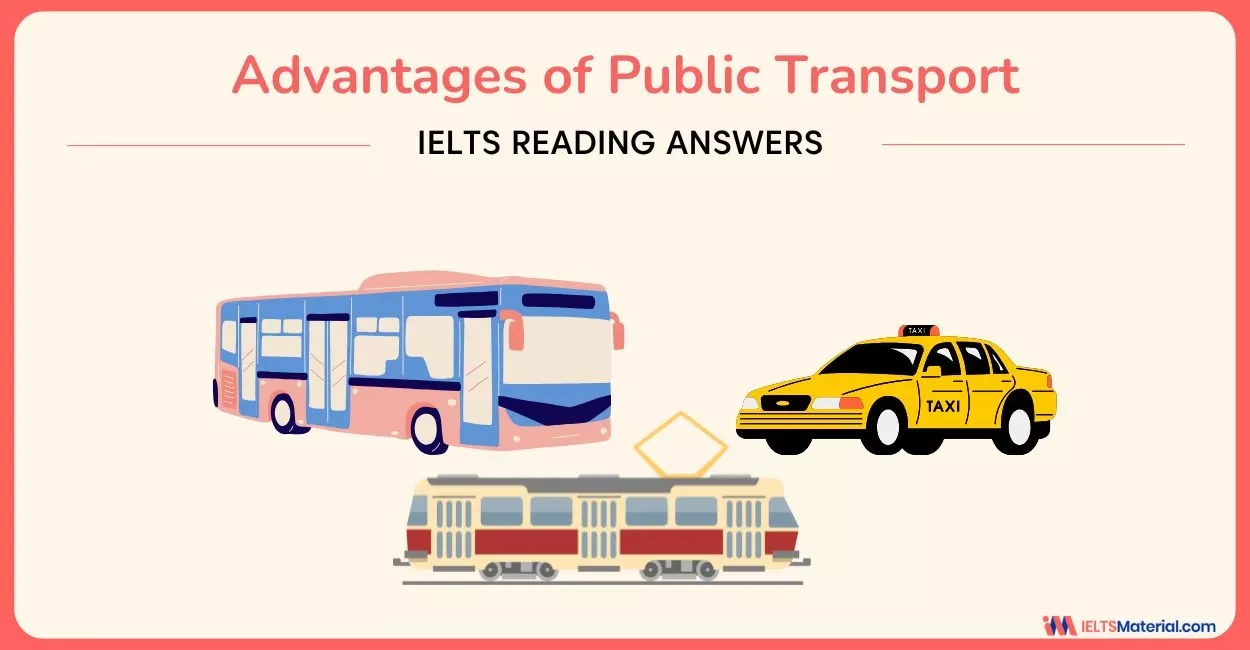
Table of Contents


Limited-Time Offer : Access a FREE 10-Day IELTS Study Plan!
The most effective IELTS readers preview the text and make predictions before diving into the questions while practising single passages like ‘Advantages of Public Transport IELTS Reading Answers’ from the best IELTS Reading books like Cambridge 6 Test 2. This pre-reading strategy sets a purpose for reading and improves focus.
So, solve the questions with the passage ‘Advantages of Public Transport Reading Answers’ given below to master the useful reading techniques. Then, check your answers against the provided location and explanations, and improve your performance in the reading module.
Passage for Advantages of Public Transport IELTS Reading Answers
Given below is the ‘Advantages of Public Transport' passage that you can go through and prepare yourself for the reading section with this IELTS Reading practice test.
You should spend about 20 minutes on Questions 1-13, which are based on the Reading Passage below.
Advantages of Public Transport
A new study conducted for the World Bank by Murdoch University's Institute for Science and Technology Policy (ISTP) has demonstrated that public transport is more efficient than cars. The study compared the proportion of wealth poured into transport by thirty-seven cities around the world. This included both the public and private costs of building, maintaining and using a transport system.
The study found that the Western Australian city of Perth is a good example of a city with minimal public transport. As a result, 17% of its wealth went into transport costs. Some European and Asian cities, on the other hand, spent as little as 5%. Professor Peter Newman, ISTP Director, pointed out that these more efficient cities were able to put the difference into attracting industry and jobs or creating a better place to live.
According to Professor Newman, the larger Australian city of Melbourne is a rather unusual city in this sort of comparison. He describes it as two cities: 'A European city surrounded by a car-dependent one'. Melbourne's large tram network has made car use in the inner city much lower, but the outer suburbs have the same car-based structure as most other Australian cities. The explosion in demand for accommodation in the inner suburbs of Melbourne suggests a recent change in many people's preferences as to where they live.
Newman says this is a new, broader way of considering public transport issues. In the past, the case for public transport has been made on the basis of environmental and social justice considerations rather than economics. Newman, however, believes the study demonstrates that 'the auto-dependent city model is inefficient and grossly inadequate in economic as well as environmental terms'.
Bicycle use was not included in the study but Newman noted that the two most 'bicycle friendly' cities considered - Amsterdam and Copenhagen - were very efficient, even though their public transport systems were 'reasonable but not special'.
It is common for supporters of road networks to reject the models of cities with good public transport by arguing that such systems would not work in their particular city. One objection is climate. Some people say their city could not make more use of public transport because it is either too hot or too cold. Newman rejects this, pointing out that public transport has been successful in both Toronto and Singapore and, in fact, he has checked the use of cars against climate and found 'zero correlation'.
When it comes to other physical features, road lobbies are on stronger ground. For example, Newman accepts it would be hard for a city as hilly as Auckland to develop a really good rail network. However, he points out that both Hong Kong and Zurich have managed to make a success of their rail systems, heavy and light respectively, though there are few cities in the world as hilly.
A In fact, Newman believes the main reason for adopting one sort of transport over another is politics: 'The more democratic the process, the more public transport is favored.' He considers Portland, Oregon, a perfect example of this. Some years ago, federal money was granted to build a new road. However, local pressure groups forced a referendum over whether to spend the money on light rail instead. The rail proposal won and the railway worked spectacularly well. In the years that have followed, more and more rail systems have been put in, dramatically changing the nature of the city. Newman notes that Portland has about the same population as Perth and had a similar population density at the time.
B In the UK, travel times to work had been stable for at least six centuries, with people avoiding situations that required them to spend more than half an hour travelling to work. Trains and cars initially allowed people to live at greater distances without taking longer to reach their destination. However, public infrastructure did not keep pace with urban sprawl, causing massive congestion problems which now make commuting times far higher.
C There is a widespread belief that increasing wealth encourages people to live farther out where cars are the only viable transport. The example of European cities refutes that. They are-often wealthier than their American counterparts but have not generated the same level of car use. In Stockholm, car use has actually fallen in recent years as the city has become larger and wealthier. A new study makes this point even more starkly. Developing cities in Asia, such as Jakarta and Bangkok, make more use of the car than wealthy Asian cities such as Tokyo and Singapore. In cities that developed later, the World Bank and Asian Development Bank discouraged the building of public transport and people have been forced to rely on cars -creating the massive traffic jams that characterize those cities.
D Newman believes one of the best studies on how cities built for cars might be converted to rail use is The Urban Village report, which used Melbourne as an example. It found that pushing everyone into the city centre was not the best approach. Instead, the proposal advocated the creation of urban villages at hundreds of sites, mostly around railway stations.
E It was once assumed that improvements in telecommunications would lead to more dispersal in the population as people were no longer forced into cities. However, the ISTP team's research demonstrates that the population and job density of cities rose or remained constant in the 1980s after decades of decline. The explanation for this seems to be that it is valuable to place people working in related fields together. 'The new world will largely depend on human creativity, and creativity flourishes where people come together face-to-face.'
Learn quick solving tips and reading techniques from experts!
Connect with us through our FREE IELTS online classes!
Questions for Advantages of Public Transport Reading Answers
The Academic passage from Cambridge 6 Test 2, Advantages of Public Transport, consists of 13 questions, presenting two different IELTS Reading question types. So, solving this passage will help you get acquainted with different IELTS Reading question types with examples.
The question types in this reading passage include:
- IELTS Reading Matching Headings (Q. 1-5)
- IELTS Reading True/False/Not Given (Q. 6-10)
- IELTS Reading Matching Features (Q. 11-13)
Questions 1-5
The Reading Passage has five marked paragraphs, A-E.
Choose the correct heading for each paragraph from the list of headings below.
Write the correct number, i-viii, in boxes 1-5 on your answer sheet.
List of Headings
i Avoiding an overcrowded centre
ii A successful exercise in people power
iii The benefits of working together in cities
iv Higher incomes need not mean more cars
v Economic arguments fail to persuade
vi The impact of telecommunications on population distribution
vii Increases in travelling time
viii Responding to arguments against public transport
1 Paragraph A
2 Paragraph B
3 Paragraph C
4 Paragraph D
5 Paragraph E
Questions 6-10
Do the following statements agree with the information given in the Reading Passage?
In boxes 6-10 on your answer sheet, write
TRUE if the statement agrees with the information
FALSE if the statement contradicts the information
NOT GIVEN if there is no information on this
6 The ISTP study examined public and private systems in every city of the world.
7 Efficient cities can improve the quality of life for their inhabitants.
8 An inner-city tram network is dangerous for car drivers.
9 In Melbourne, people prefer to live in the outer suburbs.
10 Cities with high levels of bicycle usage can be efficient even when public transport is only averagely good.
Questions 11-13
Look at the following cities ( Questions 11-13) and the list of descriptions below.
Match each city with the correct description, A-F.
Write the correct letter, A-F, in boxes 11-13 on your answer sheet.
List of Descriptions
A successfully uses a light rail transport system in hilly environment
B successful public transport system despite cold winters
C profitably moved from road to light rail transport system
D hilly and inappropriate for rail transport system
E heavily dependent on cars despite widespread poverty
F inefficient due to a limited public transport system
11 Perth
12 Auckland
13 Portland
Learn quick methods to conquer passages like this within 20 minutes.
Join our FREE IELTS webinars!
Answers and Explanations of Advantages of Public Transport IELTS Reading Passage
Please see the answer key below to improve your reading and IELTS score by learning how to approach the 'Advantages of Public Transport' questions.
1 Answer: ii
Question type: Matching Headings
Answer location: Paragraph A, Line 1 & Line 5
Answer explanation: The intro line of Paragraph A exemplifies Newman’s notion that choosing one mode of transportation over another is a political decision. Public transportation is greatly preferred when the process is more democratic. Here, Politics refers to people’s power.
In the fifth line of the same paragraph, it is quoted as, “Some years ago federal money was granted to build a new road. However, local pressure groups forced a referendum over whether to spend the money on light rail instead. The rail proposal won, and the railway worked spectacularly well.”
These quoted lines depict that federal money was granted to construct a new road. However, due to the pressure of local groups, the money was spent on rail, and the rail proposal received a nod, and the railway worked well. Thus, we understand how politics (people’s power) helped the railway project succeed. Hence, the answer is ii – A successful exercise in people power.
2 Answer: vii
Question type: Matching Headings
Answer location: Paragraph B
Answer explanation: We find traces in the first and last line of paragraph B. As quoted in the first line, “In the UK, travel times to work had been stable for at least six centuries, with people avoiding situations that required them to spend more than half an hour travelling to work.”
As quoted in the fifth line of paragraph B, “However, public infrastructure did not keep pace with urban sprawl, causing massive congestion problems which now make commuting times far higher.”
We acknowledge that public transportation did not keep up with the city’s growth, resulting in traffic congestion and longer travel times. Thus, the answer is vii- Increase in travel times. Here, “commuting” means travel, “far higher” refers to an increase.
Unlock Explanations
3 Answer: iv
Question type: Matching Headings
Answer location: Paragraph C, line 1
Answer explanation: When we scan paragraph C, it is quoted as, “there is a widespread belief that increasing wealth encourages people to live farther out where cars are the only viable transport. The example of European cities refutes that. They are often wealthier than their American counterparts but have not generated the same level of car use. In Stockholm, car use has actually fallen in recent years as the city has become larger and wealthier.”
We deduce from the quoted lines that according to a general belief, higher incomes encourage people to live in distant places where cars are the feasible type of transport. However, an example disproves this belief. European countries are more affluent than the American cities, but they have not used the same level of cars as Americans. Despite the fact that Stockholm is growing and becoming more prosperous, car use has fallen in recent years. So, the answer that best fits paragraph C is iv – Higher incomes need not mean more cars. Here, “affluent” means wealthier, “distant places” mean farther, “disprove” means refutes, and “feasible” means viable.
4 Answer: i
Question type: Matching Headings
Answer location: Paragraph D
Answer explanation: When we look into paragraph D, it is quoted as, “Newman believes one of the best studies on how cities built for cars might be converted to rail use is The Urban Village report, which used Melbourne as an example. It found that pushing everyone into the city centre was not the best approach.”
We understand from the passage that Newman considered the Urban Village report as one of the best studies on how cities built for cars might be converted into rail use. The report illustrates Melbourne as an example. It is found that overcrowding the centre is not the best approach. Thus, the answer is i.
5 Answer: iii
Question type: Matching Headings
Answer location: Paragraph E, Line 5
Answer explanation: We can find traces of information in the fifth line of Paragraph E, where it is quoted, “The explanation for this seems to be that it is valuable to place people working in related fields together. ‘The new world will largely depend on human creativity, and creativity flourishes where people come together face-to-face.”
The quoted lines indicate that it is valuable to place people working in related fields together, which means there are benefits of working together in the same cities. So, the answer is iii.
6 Answer: False
Question type: True/False/Not Given
Answer location: Paragraph 1
Answer explanation: We can find references for the given statement in the first paragraph, introducing the new study conducted for the World Bank by Murdoch University’s Institute for Science and Technology Policy (ISTP). According to the study, public transport is more efficient than cars, and it compared the proportion of wealth poured into transport by 37 cities around the world.
We understand from this that the study examined public and private transport systems in only 37 cities, not in every city in the world. So, the answer is False.
7 Answer: True
Question type: True/False/Not Given
Answer location: Paragraph 2, line 4
Answer explanation: We find traces of information for the statement in the 2nd paragraph where Professor Peter Newman, ISTP Director, highlighted that European and Asian cities are efficient and can put the difference in attracting industry and jobs and improving the quality of life of their residents. So, the answer is True.
8 Answer: Not Given
Question type: True/False/Not Given
Answer location: Paragraph 3, line 4
Answer explanation: We can find references for the answer in the fourth line of paragraph 3, where it is quoted “Melbourne’s large tram network has made car use in the inner city much lower, but the outer suburbs have the same car-based structure as most other Australian cities.”
The quoted lines indicate that the large tram network of Melbourne made car use in the inner city much lower. But, there is no reference to an inner-city tram network being dangerous for car drivers. Hence, the answer is Not Given.
9 Answer: False
Question type: True/False/Not Given
Answer location: Paragraph 3, line 7
Answer explanation: We can find a reference for the information in the seventh line of paragraph 3, where it is quoted, “The explosion in demand for accommodation in the inner suburbs of Melbourne suggests a recent change in many people’s preferences as to where they live.”
We can deduce from the mentioned lines that many people’s preferences for where they should live have recently shifted due to increasing demand for accomodation in Melbourne’s inner suburbs. The statement in the question contradicts the information in the passage. Hence, the answer is False.
10 Answer: True
Question type: True/False/Not Given
Answer location: Paragraph 5
Answer explanation: We can trace the information in Paragraph 5, where it is quoted, “Bicycle use was not included in the study, but Newman noted that the two most ‘bicycle friendly’ cities considered – Amsterdam and Copenhagen – were very efficient, even though their public transport systems were ‘reasonable but not special.”
These quoted lines indicate that the study didn’t include bicycle use. However, Newman pointed out that Amsterdam and Copenhagen were the two bicycle-friendly cities that were efficient, despite having reasonable and mediocre public transport systems. Here, cities with high levels of bicycle usage refer to Amsterdam and Copenhagen, which were very efficient, and their public transport systems were also reasonably well. Here, ”mediocre” means not special. Thus, the statement in the question agrees with the information in the passage; hence, the answer is True.
11 Answer: F
Question type: Matching Features
Answer location: Paragraph 2,line 1
Answer explanation: In the first line of the 2nd paragraph, it is mentioned that according to a study, the Western Australian city of Perth is an excellent example of a city with minimal public transport. As a result, 17% of its wealth went into transport costs. Some European and Asian cities, on the other hand, spent as little as 5%.
These lines indicate that despite Perth using 17% of its wealth into transport costs, their public transport system is limited. Thus, the answer is F. Here, “limited” refers to minimal.
12 Answer: D
Question type: Matching Features
Answer location: Paragraph 7, line 2
Answer explanation: We can find traces for Auckland in Paragraph 7, where Newman has accepted that it would be difficult for a city as hilly as Auckland to develop a really good rail network. We understand that as Auckland is a hilly city, it would be inappropriate to develop a rail transport system. Thus, the answer is D.
13 Answer: C
Question type: Matching Features
Answer location: Paragraph A, line 3
Answer explanation: In the third line of paragraph A, we can locate the keyword Portland. It is quoted as, “He considers Portland Oregon, a perfect example of this. Some years ago, federal money was granted to build a new road. However, local pressure groups forced a referendum over whether to spend the money on light rail instead. The rail proposal won, and the railway worked spectacularly well.”
These quoted lines illustrate Newman considering Portland, Oregon, as a perfect example for favouring the public transport system. We understand that federal funds had been allocated to constructing a new road. On the other hand, local residents decided to spend the money on light rail rather than roads. As a result, the rail plan won, and the railway’s construction went off without a hitch. So, the answer is C.
Well done on completing the Advantages of Public Transport IELTS Reading Answers! Practising reading samples like this one and IELTS Reading practice tests are crucial. In order to improve your reading speed, you need to implement effective reading techniques, which will enable you to pinpoint the areas where you struggle, which will ultimately allow you to better answer the various types of questions that are used to assess your reading comprehension.
Useful Links:
- Tomato Ripening - IELTS Reading Answers
- Hello Happiness - IELTS Reading Answers
- Guide to entertainment in Westhaven - IELTS Reading Sample Answers
- Bumblebee Conservation - IELTS Reading Answers
- Space Travel And Health- IELTS Reading Answers
- A New Planet is Discovered- IELTS Reading Answer
- 101 IELTS Academic Reading Past Test Papers with Answers PDF Download
Practice IELTS Reading based on question types

Start Preparing for IELTS: Get Your 10-Day Study Plan Today!

Explore other Reading Actual Tests
Kasturika Samanta
Prity Mallick

Kasturika Samanta

Kasturika Samanta

Recent Articles

Nehasri Ravishenbagam

Haniya Yashfeen

Haniya Yashfeen

Haniya Yashfeen


Post your Comments