Communicating Styles And Conflict - IELTS Reading Answers
5 min read
Updated On
-
Copy link
This blog offers complete IELTS Reading answers for Communicating Styles and Conflict, with step-by-step explanations and useful tips for every question type to help you understand the passage, improve accuracy, & boost your band score.
Table of Contents


Limited-Time Offer : Access a FREE 10-Day IELTS Study Plan!
The Reading Module of the IELTS can be the top scoring category, with diligent practice. To achieve the best results in this section, you must understand how to approach and answer the different Question types in the Reading Module. By solving and reviewing Sample Reading Questions from past IELTS papers, you can ensure that your Reading skills are up to the mark. The Academic passage ‘Communicating Styles And Conflict’ is a reading passage that appeared in an IELTS Test.
Since questions get repeated in the IELTS exam, these passages are ideal for practice. If you want more practice, try taking an IELTS reading practice test.
Communicating Styles And Conflict IELTS Reading Passage
You should spend about 20 minutes on Questions 1-13, which are based on the Reading Passage below.
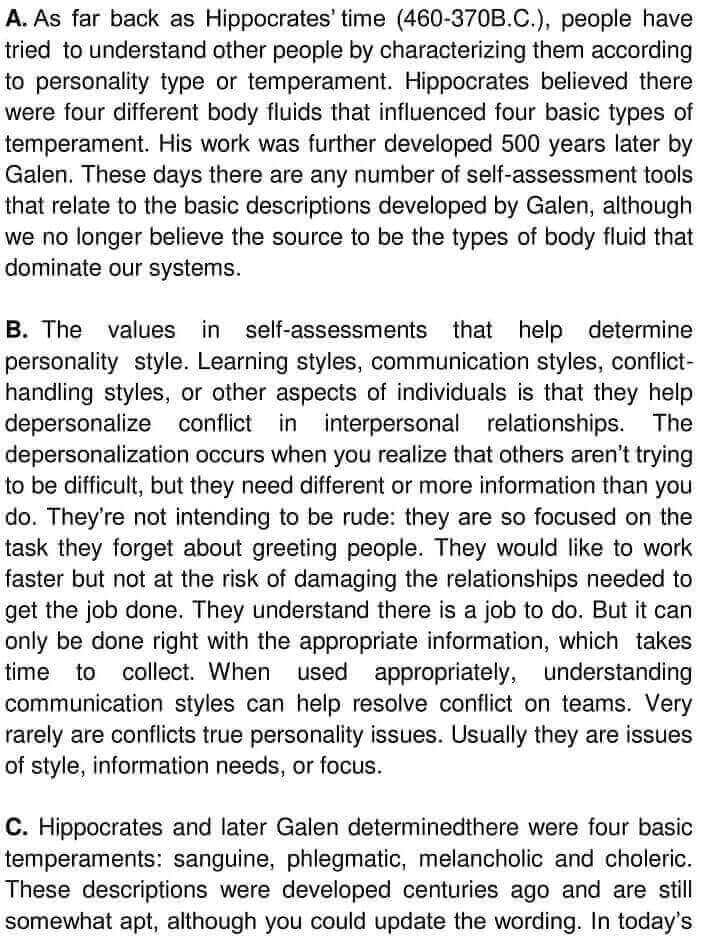
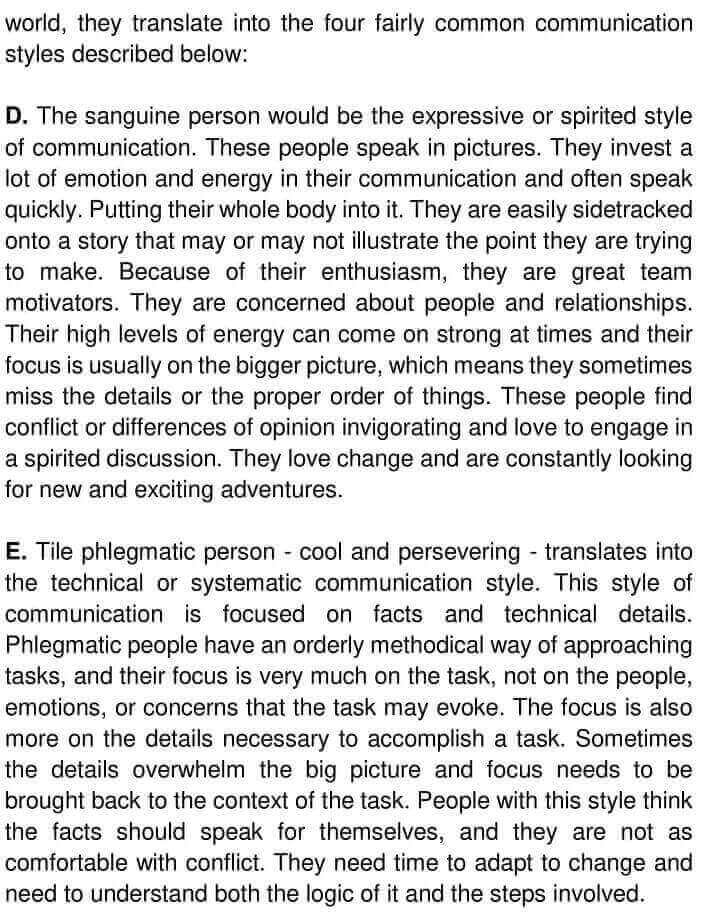
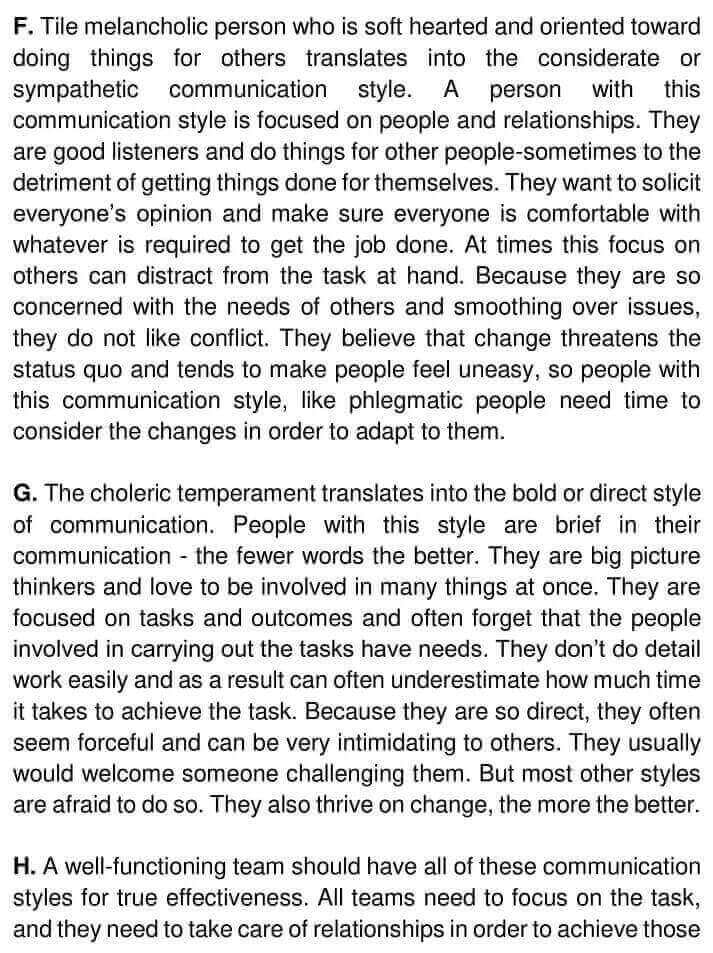
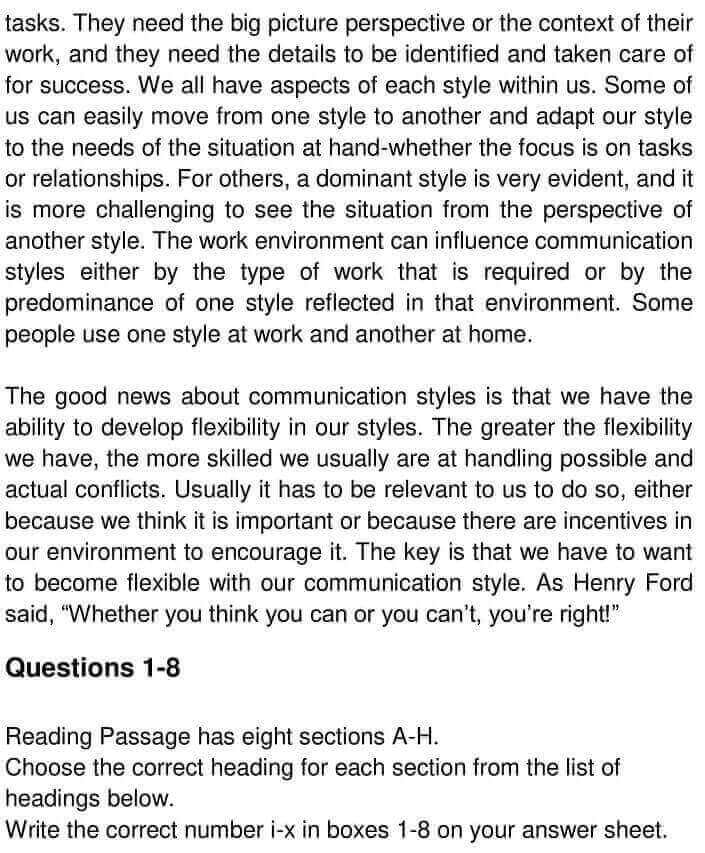
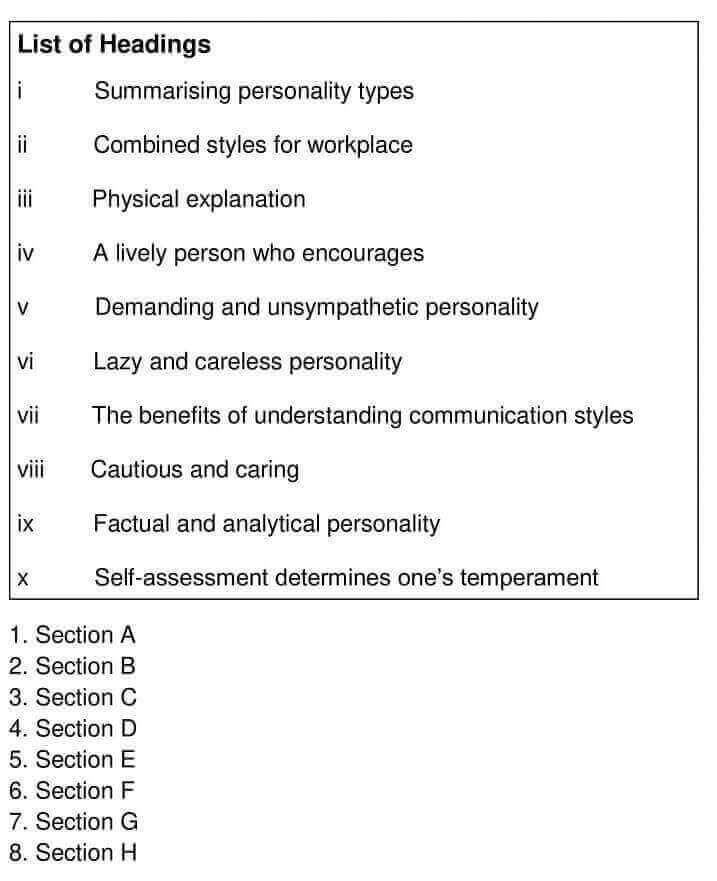
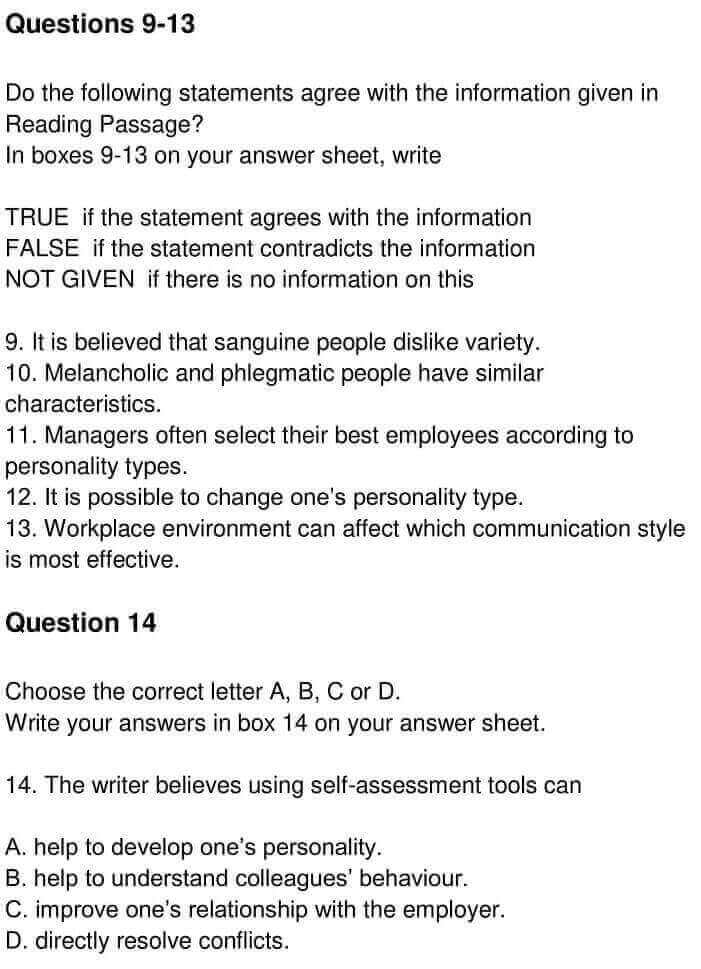
Boost your IELTS Academic Reading score today! Grab Get Your IELTS Reading Ebook Now!
Communicating Styles And Conflict IELTS Reading Answers
Let’s now review the answers to the questions from the passage in the reading section, Communicating Styles And Conflict - IELTS Reading Answers, and assess your improvement for a high IELTS Reading band score.
| Question number | Answer | Keywords | Location of keywords |
|---|---|---|---|
| 1 | iii | Hippocrates believed there were four different body fluids that influenced four basic types of temperament. | Paragraph A;
Line 2 |
| 2 | vii | The values in self-assessments that help determine personality style. | Paragraph B;
Line 1 |
| 3 | i | there were four basic temperaments: sanguine, phlegmatic, melancholic and choleric | Paragraph C;
Line 1 |
| 4 | iv | Because of their enthusiasm, they are great team motivators. | Paragraph D;
Line 5 |
| 5 | ix | Tile phlegmatic person – cool and persevering – translates into the technical or systematic communication style | Paragraph E;
Line 1 |
| 6 | viii | Tile melancholic person who is soft hearted and oriented toward doing things for others translates into the considerate or sympathetic communication style | Paragraph F;
Line 1 |
| 7 | v | They are focused on tasks and outcomes and often forget that the people involved in carrying out the tasks have needs | Paragraph G;
Line 4 |
| 8 | ii | A well-functioning team should have all of these communication styles for true effectiveness | Paragraph H;
Line 1 |
| 9 | FALSE | They love change and are constantly looking for new and exciting adventures. | Paragraph D;
Last line |
| 10 | TRUE | so people with this communication style, like phlegmatic people need time to consider the changes in order to adapt to them. | Paragraph F;
Last line |
| 11 | NOT GIVEN | – | – |
| 12 | TRUE | Some of us can easily move from one style to another and adapt our style to the needs of the situation at hand-whether the focus is on tasks or relationships. | Paragraph H;
Line 4 |
| 13 | TRUE | The work environment can influence communication styles either by the type of work that is required or by the predominance of one style reflected in that environment | Paragraph H;
Line 6 |
| 14 | B | people have tried to understand other people by characterizing them according to personality type or temperament | Paragraph A;
Line 1 |
Tips to Ace Communicating Styles And Conflict - IELTS Reading Answers
Let us check out some quick IELTS Exam Preparation Tips for Band Score of 8+ to answer the types of questions in the Reading Answers.
True / False / Not Given
- Read the statement first, then locate the relevant part of the passage.
- FALSE means the passage says the opposite, not just different words.
- NOT GIVEN means the information is missing, not unclear.
- Watch out for absolute words (always, never, only) — they’re often traps.
- Do not use your own knowledge; rely only on the text.
Matching Headings
- Read all headings first and underline keywords.
- Focus on the main idea of each paragraph, not details.
- Ignore examples and explanations when choosing a heading.
- Some headings will be distractors — you won’t use all of them.
- Decide after reading the whole paragraph, not just the first line.
Multiple Choice Questions
- Read the question first, then the options
Know exactly what’s being asked before you let the options mess with your head. - Eliminate wrong answers immediately
Even knocking out 1–2 options boosts your odds a lot. Be ruthless. - Watch for keywords
Words like always, never, except, most likely are huge clues. Don’t skim past them. - Don’t overthink
Your first instinct is often right—especially if you’ve studied. Overthinking = traps. - Manage your time smartly
Skip tough ones, answer the easy wins first, then come back with a calmer brain.
Want to boost your IELTS score? Enroll in our expert-led IELTS online classes today!
In conclusion, the IELTS Reading passage “Communicating Styles And Conflict - IELTS Reading Answers” allows candidates to practise a range of question types while improving comprehension and information-identifying skills. With complete answers, keyword locations, and explanations, this article helps learners understand the passage more effectively, enhance accuracy, and boost their overall IELTS Reading score. Keep practising with more IELTS Reading Recent Actual Tests and answers on IELTSMaterial.com to improve your speed, accuracy, and overall performance.
Check More IELTS Reading Answers
Practice IELTS Reading based on question types

Start Preparing for IELTS: Get Your 10-Day Study Plan Today!

Recent Articles

Nehasri Ravishenbagam
Haniya Yashfeen

Haniya Yashfeen

Haniya Yashfeen


Post your Comments