(Esperanto) One Who Hopes - IELTS Reading Answers
7 min read
Updated On
-
Copy link
This blog inlcudes the IELTS Academic Reading passage “(Esperanto) One Who Hopes," with full answers, detailed explanations, and expert tips. Enhance your understanding of all question types, improve accuracy, and boost your IELTS band score.
Table of Contents


Limited-Time Offer : Access a FREE 10-Day IELTS Study Plan!
The Academic passage ‘(esperanto) One Who Hopes’ is a reading passage that appeared in an IELTS Test. With diligent practice, the Reading Module can be the top-scoring category for IELTS Aspirants. To score well, you must understand how to approach and answer the different question types in the Reading Module.
By solving and reviewing Sample Reading Questions from past IELTS papers, you can ensure that your Reading skills are up to the mark. Take the practice test (esperanto) One Who Hopes below and try more IELTS reading practice tests from IELTSMaterial.com.
(Esperanto) One Who Hopes - IELTS Reading Passage
You should spend about 20 minutes on Questions 14 - 26, which are based on the Reading Passage below.
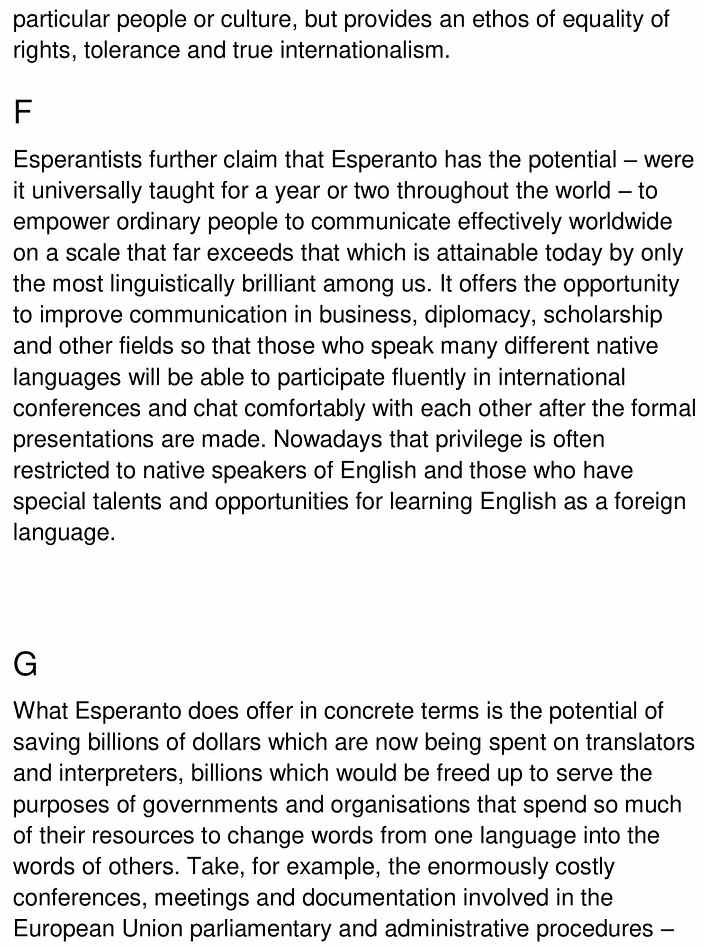
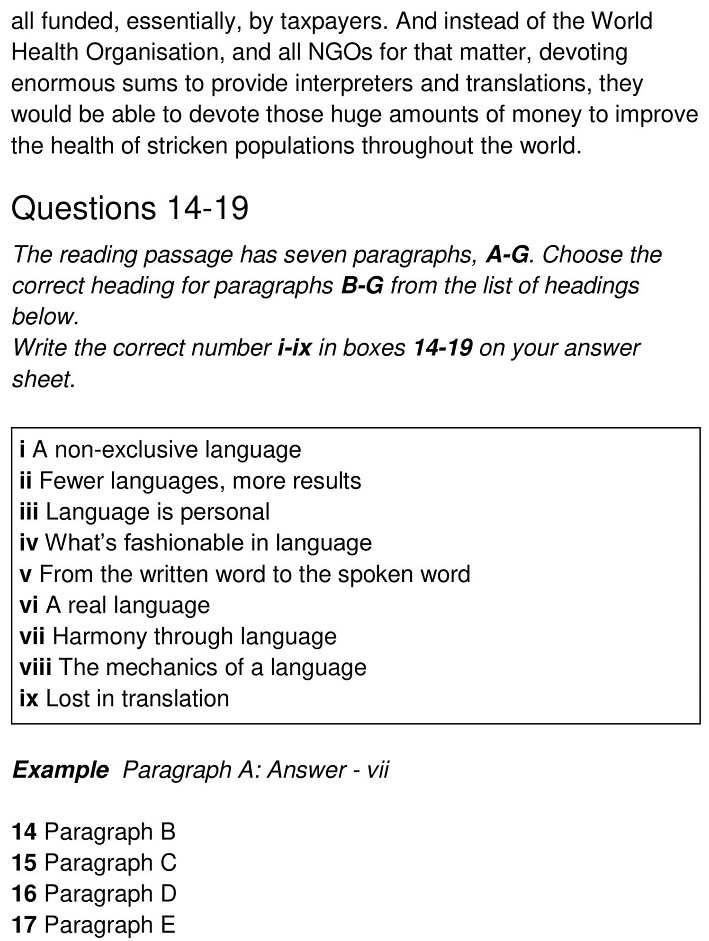
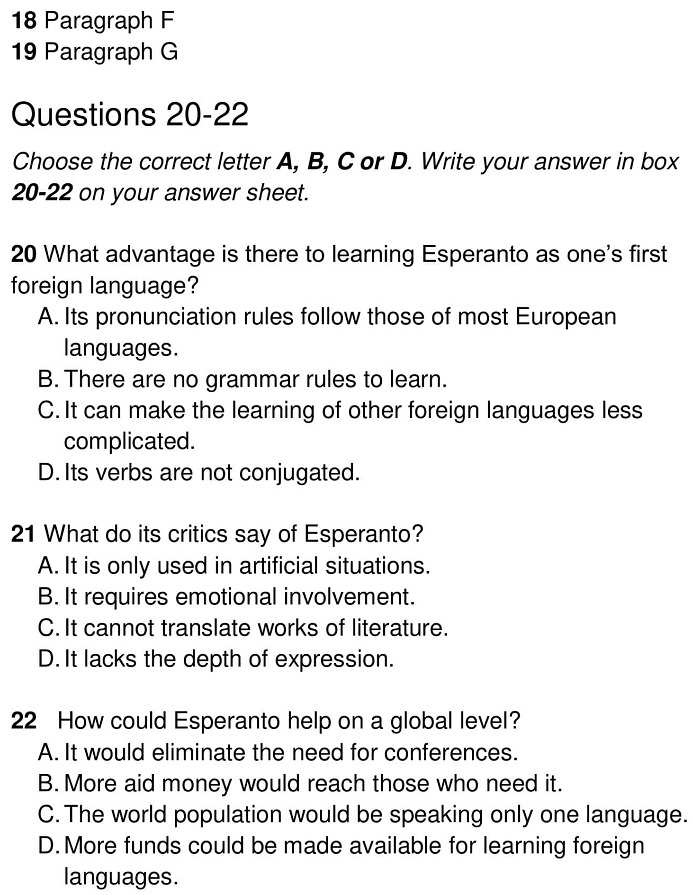
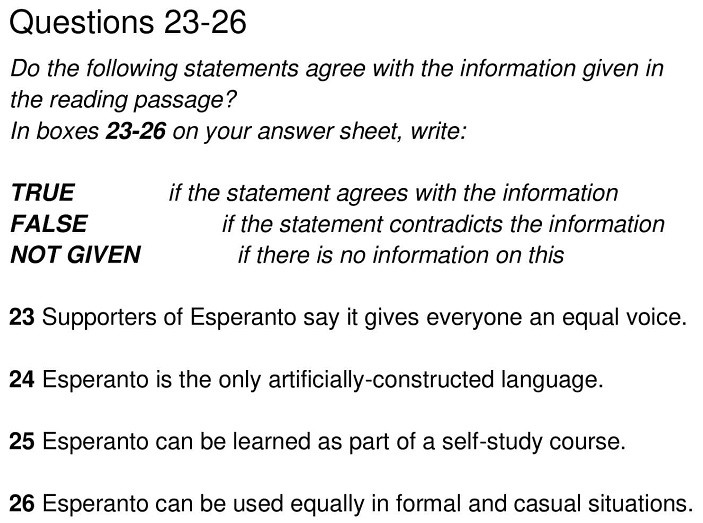
(Esperanto) One Who Hopes - IELTS Reading Answers
Let’s now review the answers to the questions from the passage in the reading section,(Esperanto) One Who Hopes - IELTS Reading Answers, and assess your improvement for a high IELTS Reading band score.
| Question number | Answer | Explanation |
|---|---|---|
| 14 | v | Paragraph B states that ‘Esperanto grammar was published in Warsaw in July 1887. The number of speakers grew rapidly.’ The line suggests that this passage discusses Esperanto grammar usage increasing from written to spoken words. Hence, the appropriate heading is “v.” |
| 15 | viii | In paragraph C, a line states that ‘it has one simple way of conjugating all of its verbs. Words are often made from many other roots.’ From this earlier line, we can infer that this passage discusses the technicalities of language. Hence, the appropriate heading is “viii.” |
| 16 | iii | Paragraph D mentions that ‘language as being harsh and difficult to pronounce, and argue that Esperanto has an artificial feel to it, without the flow of a natural tongue, and that by nature of its artificiality, it is impossible to become emotionally involved with the language.’ As per the line, “because it’s difficult to be involved emotionally” we understand that language is personal Hence, the appropriate heading is “iii.” |
| 17 | vi | Paragraph E puts forward this idea that ‘language in which a great body of world literature has appeared in translation: in poetry, novels, literary journals, and, to rebut the accusation that it is not a ‘real’ language.’ From the line mentioned earlier, we can deduce that this passage discusses language being real or not. Hence, the appropriate heading is “vi.” |
| 18 | i | According to paragraph F, ‘to empower ordinary people to communicate effectively worldwide on a scale that far exceeds.’ This line from the passage signifies that it discusses language being non-exclusive by universally applying to all people. Hence, the appropriate heading is “i.” |
| 19 | ii | Paragraph G conveys that ‘the potential of saving billions of dollars which are now being spent on translators and interpreters.’ The earlier mentioned line signifies that billions are getting spent on translators because there are many languages. Therefore it implies that if there will be fewer languages, the savings of the government will be more. Hence, the appropriate heading is “ii.” |
| 20 | C | According to paragraph C, ‘learning subsequent foreign language is easier than learning one’s first, while the use of a grammatically simple and culturally flexible language like Esperanto softens the blows of learning one’s first foreign language.’ The phrase ‘softens the blows of learning’ signifies it is less complicated and flexible to follow, which is why Esperanto, as one’s first foreign language, makes the learning of other foreign languages easy. There is also a reference to how learning Esperanto for a year and then learning French for 3 years resulted in better understanding of French. Hence, the appropriate heading is “C.” |
| 21 | D | Paragraph D discusses the ‘inability to express all the necessary philosophical, emotional and psychological concepts.’ The inability to express signifies the lack of depth of expression. Hence, the appropriate heading is “D.” |
| 22 | B | The last line of paragraph G signifies that ‘they would be able to devote those huge amounts of money to improving the health of stricken populations throughout the world.’ From this line, we can infer that more money help (aid) would reach those who need it (health stricken population). Hence, the appropriate heading is “B.” |
| 23 | TRUE | The last line of paragraph E states that ‘Esperanto does not give advantages to the members of any particular people or culture, but provides an ethos of equality of rights.’ All these factors mentioned in the earlier line imply that Esperanto’s supporters say it gives everyone an equal voice. As the statement agrees with the information, the correct answer is “TRUE.” |
| 24 | FALSE | Paragraph A claims that ‘Esperanto is the most widely spoken artificially constructed international language.’ It is the most universally spoken artificial international language. However, it is not the only artificial language. As the statement contradicts the information, the correct answer is “FALSE.” |
| 25 | NOT GIVEN | None of the passages mentions if Esperanto can or cannot be learned as part of a self-study course. Hence, the correct answer is “NOT GIVEN.” |
| 26 | TRUE | The lines in paragraph E mentions that ‘members of any particular people or culture, but provides an ethos of equality of rights, tolerance and true internationalism.’ If anyone can use it – means it can be used equally in formal and casual situations. As the statement agrees with the information, the correct answer is “TRUE.” |
Tips to Ace (Esperanto) One Who Hopes - IELTS Reading Answers
Let us check out some quick IELTS Exam Preparation Tips for Band Score of 8+ to answer the types of questions in the Reading Answers.
Matching Paragraphs
- Read the headings first
Skim through all the headings to understand the range of ideas. This helps you predict what to look for while reading each paragraph. - Focus on the main idea, not details
Matching paragraphs tests your ability to identify the central theme of a paragraph, not specific facts, examples, or names. - Read the first and last sentences carefully
Topic sentences and concluding lines often reveal the paragraph’s overall purpose and guide you to the correct heading. - Watch out for similar or misleading headings
Some headings may use similar words but express different ideas. Choose the heading that best summarizes the entire paragraph. - One heading is extra—use elimination
Since one heading is not used, cross out headings as you match them. This reduces confusion and saves time.
Multiple Choice Questions (MCQs)
- Underline keywords in the question – Focus on the main idea rather than minor details.
- Eliminate wrong options – Remove clearly incorrect choices to increase your chance of selecting the right answer.
- Watch for synonyms – The passage may use different words to express the same meaning as the options.
- Be careful with extreme words – Words like always, never, all, or only are often traps.
- Refer back to the passage – Don’t rely on memory; confirm your answer by scanning the text.
Yes / No / Not Given or True / False / Not Given
- Understand the difference – Yes/True → matches the author’s view; No/False → contradicts; Not Given → no information.
- Focus on opinion vs. fact – Statements about opinions or claims need careful attention; facts vs. interpretation are different.
- Don’t assume – Only use information in the passage; your own knowledge is irrelevant.
- Look for keywords and paraphrases – The statement may be reworded; scan the passage for meaning rather than exact words.
- Be careful with negatives – Words like not, few, rarely can completely change the meaning.
Want to boost your IELTS score? Enroll in our expert-led IELTS online classes today!
In conclusion, the IELTS Reading passage “(Esperanto) One Who Hopes - IELTS Reading Answers” allows candidates to practise a range of question types while improving comprehension and information-identifying skills. With complete answers, keyword locations, and explanations, this article helps learners understand the passage more effectively, enhance accuracy, and boost their overall IELTS Reading score. Keep practising with more IELTS Reading Recent Actual Tests and answers on IELTSMaterial.com to improve your speed, accuracy, and overall performance.
Check More IELTS Reading Answers
Practice IELTS Reading based on question types

Start Preparing for IELTS: Get Your 10-Day Study Plan Today!

Recent Articles

Nehasri Ravishenbagam
Haniya Yashfeen

Haniya Yashfeen

Haniya Yashfeen


Post your Comments