Facial Expression - IELTS Reading Answers
14 min read
Updated On
-
Copy link
Enhance your IELTS reading band score to 8 and above with the 'Facial Expression' IELTS reading passage, along with its answer key. Additionally, learn to tackle various IELTS reading questions with the tips provided here and refine your reading strategy.
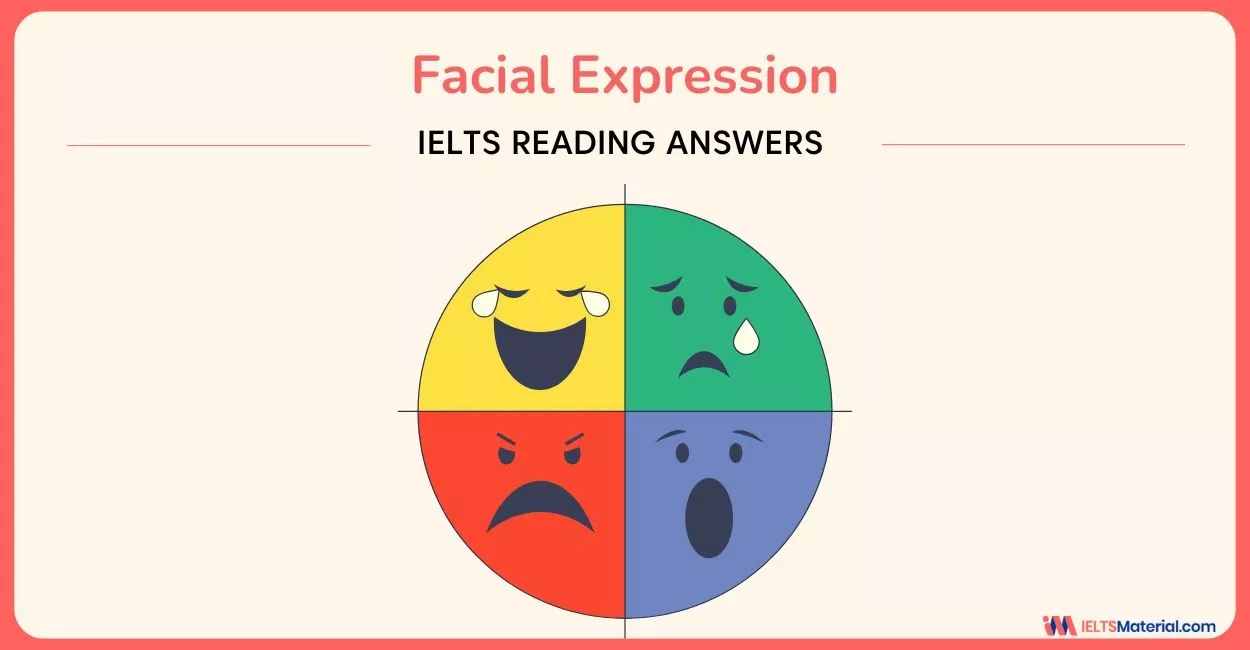
Table of Contents


Limited-Time Offer : Access a FREE 10-Day IELTS Study Plan!
Practicing individual IELTS Reading passages helps you recognize the varying difficulty levels across texts. By focusing on passages like ‘Facial Expression IELTS Reading Answers’, you can distinguish between simple factual texts and more complex analytical ones, allowing you to adjust your reading strategy effectively for the exam.
Solve the questions for the passage ‘Facial Expression Reading Answers’, check your answers against the provided location and explanations, and improve your performance in the reading module with the given IELTS Reading tips and techniques to increase your reading speed.
Passage for Facial Expression IELTS Reading Answers
Now go through the passage for ‘Facial Expression’ Reading Answers given below, and be prepared to solve more IELTS Reading recent actual tests.
You should spend about 20 minutes on Questions 28-40, which are based on the Reading Passage below.
Facial Expression
A A facial expression is one or more motions or positions of the muscles in the skin. These movements convey the emotional state of the individual to observers. Facial expressions are a form of nonverbal communication. They are a primary means of conveying social information among aliens, but also occur in most other mammals and some other animal species. Facial expressions and their significance in the perceiver can, to some extent, vary between cultures with evidence from descriptions in the works of Charles Darwin.
B Humans can adopt a facial expression to read as a voluntary action. However, because expressions are closely tied to emotion, they are more often involuntary. It can be nearly impossible to avoid expressions for certain emotions, even when it would be strongly desirable to do so; a person who is trying to avoid insulting an individual he or she finds highly unattractive might, nevertheless, show a brief expression of disgust before being able to reassume a neutral expression. Microexpressions are one example of this phenomenon. The close link between emotion and expression can also work in the order direction; it has been observed that voluntarily assuming an expression can actually cause the associated emotion.
C Some expressions can be accurately interpreted even between members of different species – anger and extreme contentment being the primary examples. Others, however, are difficult to interpret even in familiar individuals. For instance, disgust and fear can be tough to tell apart. Because faces have only a limited range of movement, expressions rely upon fairly minuscule differences in the proportion and relative position of facial features, and reading them requires considerable sensitivity to the same. Some faces are often falsely read as expressing some emotion, even when they are neutral because their proportions naturally resemble those another face would temporarily assume when emoting.
D Also, a person’s eyes reveal much about how they are feeling, or what they are thinking. Blink rate can reveal how nervous or at ease a person may be. Research by Boston College professor Joe Tecce suggests that stress levels are revealed by blink rates. He supports his data with statistics on the relation between the blink rates of presidential candidates and their success in their races. Tecce claims that the faster blinker in the presidential debates has lost every election since 1980. Though Tecce’s data is interesting, it is important to recognize that non-verbal communication is multi-channelled, and focusing on only one aspect is reckless. Nervousness can also be measured by examining each candidates’ perspiration, eye contact and stiffness.
E As Charles Darwin noted in his book The Expression of the Emotions in Man and Animals: the young and the old of widely different races, both with man and animals, express the same state of mind by the same movements. Still, up to the mid-20th century, most anthropologists believed that facial expressions were entirely learned and could, therefore, differ among cultures. Studies conducted in the 1960s by Paul Ekman eventually supported Darwin’s belief to a large degree.
F Ekman’s work on facial expressions had its starting point in the work of psychologist Silvan Tomkins. Ekman showed that contrary to the belief of some anthropologists including Margaret Mead, facial expressions of emotion are not culturally determined, but universal across human cultures. The South Fore people of New Guinea were chosen as subjects for one such survey. The study consisted of 189 adults and 130 children from among a very isolated population, as well as twenty-three members of the culture who lived a less isolated lifestyle as a control group. Participants were told a story that described one particular emotion; they were then shown three pictures (two for children) of facial expressions and asked to match the picture which expressed the story’s emotion.
G While the isolated South Fore people could identify emotions with the same accuracy as the non-isolated control group, problems associated with the study include the fact that both fear and surprise were constantly misidentified. The study concluded that certain facial expressions correspond to particular emotions and can not be covered, regardless of cultural background, and regardless of whether or not the culture has been isolated or exposed to the mainstream.
H Expressions Ekman found to be universally included those indicating anger, disgust, fear, joy, sadness, and surprise (not that none of these emotions has a definitive social component, such as shame, pride, or schadenfreude). Findings on contempt (which is social) are less clear, though there is at least some preliminary evidence that this emotion and its expression are universally recognized. This may suggest that the facial expressions are largely related to the mind and each part on the face can express specific emotion.
Questions for Facial Expression Reading Answers
The passage, Facial Expression Reading Answers, consists of 13 questions, which showcase three different IELTS Reading question types. They are:
- IELTS Reading Summary Completion (Q. 28-32)
- IELTS Reading Matching Information (Q. 33-38)
- IELTS Reading Multiple Choice Questions (Q. 39-40)
Questions 28-32
The result of Ekman’s study demonstrates that fear and surprise are persistently 28…………………… and made a conclusion that some facial expressions have something to do with certain 29…………………. which is impossible covered, despite of 30………………….. and whether the culture has been 31…………………… or 32………………………. to the mainstream.
Questions 33-38
The reading Passage has seven paragraphs A-H
Which paragraph contains the following information?
Write the correct letter A-H, in boxes 33-38 on your answer sheet.
NB You may use any letter more than once.
33 the difficulty identifying the actual meaning of facial expressions
34 the importance of culture on facial expressions is initially described
35 collected data for the research on the relation between blink and the success in elections
36 the features on the sociality of several facial expressions
37 an indicator to reflect one’s extent of nervousness
38 the relation between emotion and facial expressions
Questions 39-40
Choose two letters from the A-E
Write your answers in boxes 39-40 on your answer sheet
Which two of the following statements are true according to Ekman’s theory?
A No evidence shows animals have their own facial expressions.
B The potential relationship between facial expression and state of mind exists
C Facial expressions are concerning different cultures.
D Different areas on face convey a certain state of mind.
E Mind controls men’s facial expressions more obvious than women’s
Learn quick methods to conquer passages like this within 20 minutes.
Join our FREE IELTS webinars!
Answers and Explanations of Facial Expression IELTS Reading Passage
Check out the 'Facial Expression' answers to evaluate your improvement in achieving a high reading band score. This section will help you review the answers given, along with the key terms that are important for finding the answers.
28 Answer: misidentified
Question type: Summary Completion
Answer location: Paragraph G, line 1 – line 3
Answer explanation: The following line from Paragraph G states that “While the isolated South Fore people could identify emotions with the same accuracy as the non-isolated control group, problems associated with the study include the fact that both fear and surprise were constantly misidentified.” This clearly indicates that both fear and surprise were two expressions that were constantly misidentified. Hence the answer is ‘misidentified’.
29 Answer: emotions
Question type: Summary Completion
Answer location: Paragraph G, line 3 – line 5
Answer explanation: The following line from Paragraph G states that “The study concluded that certain facial expressions correspond to particular emotions and can not be covered, regardless of cultural background, and regardless of whether or not the culture has been isolated or exposed to the mainstream.” This indicates that some facial expressions have something to do with certain emotions. Hence the answer is ‘emotions’.
30 Answer: cultural background
Question type: Summary Completion
Answer location: Paragraph G, line 3 – line 5
Answer explanation: The following line from Paragraph G states that “The study concluded that certain facial expressions correspond to particular emotions and can not be covered, regardless of cultural background, and regardless of whether or not the culture has been isolated or exposed to the mainstream.” This suggests that certain facial expressions cannot be covered by the study, regardless (despite) of cultural background. Hence the answer is ‘cultural background’.
31 Answer: isolated
Question type: Summary Completion
Answer location: Paragraph G, line 3 – line 5
Answer explanation: The following line from Paragraph G states that “The study concluded that certain facial expressions correspond to particular emotions and can not be covered, regardless of cultural background, and regardless of whether or not the culture has been isolated or exposed to the mainstream.” This suggests that certain facial expressions cannot be covered by the study, regardless of whether culture has been isolated from the mainstream. Hence the answer is ‘isolated’.
32 Answer: exposed
Question type: Summary Completion
Answer location: Paragraph G, line 3 – line 5
Answer explanation: The following line from Paragraph G states that “The study concluded that certain facial expressions correspond to particular emotions and can not be covered, regardless of cultural background, and regardless of whether or not the culture has been isolated or exposed to the mainstream.” This suggests that certain facial expressions cannot be covered by the study, regardless of whether culture has been exposed to the mainstream. Hence the answer is exposed.
33 Answer: C
Question type: Matching Information
Answer location: Paragraph C, line 4 – line 8
Answer explanation: The following lines from Paragraph C state that “Because faces have only a limited range of movement, expressions rely upon fairly minuscule differences in the proportion and relative position of facial features, and reading them requires considerable sensitivity to the same. Some faces are often falsely read as expressing some emotion, even when they are neutral because their proportions naturally resemble those another face would temporarily assume when emoting.” From this, we can understand that facial expressions can be difficult to interpret due to the limited range of movement allowed by our facial features. Hence the answer is C.
Unlock Explanations
34 Answer: A
Question type: Matching Information
Answer location: Paragraph A, line 4 – line 6
Answer explanation: The following line from Paragraph A states that “Facial expressions and their significance in the perceiver can, to some extent, vary between cultures with evidence from descriptions in the works of Charles Darwin.” This suggests that cultural background has some significance when it comes to facial expressions, and the same is described by Charles Darwin. Hence the answer is A.
35 Answer: D
Question type: Matching Information
Answer location: Paragraph D, line 1 – line 6
Answer explanation: The following lines from Paragraph D state that “Blink rate can reveal how nervous or at ease a person may be. Research by Boston College professor Joe Tecce suggests that stress levels are revealed by blink rates. He supports his data with statistics on the relation between the blink rates of presidential candidates and their success in their races. Tecce claims that the faster blinker in the presidential debates has lost every election since 1980.” This indicates that blink rate can reveal the mental state of an individual and this data has been used to determine the success rate of presidential candidates during elections. Hence the answer is D.
36 Answer: H
Question type: Matching Information
Answer location: Paragraph H, line 1 – line 5
Answer explanation: The following lines from Paragraph H state that “Expressions Ekman found to be universally included those indicating anger, disgust, fear, joy, sadness, and surprise (not that none of these emotions has a definitive social component, such as shame, pride, or schadenfreude). Findings on contempt (which is social) are less clear, though there is at least some preliminary evidence that this emotion and its expression are universally recognized.” This suggests that certain facial expressions have a definitive social component like anger, disgust, fear, joy, sadness and surprise and thus are easier to identify whereas others like shame, pride, etc are difficult to identify because of less cultural significance. Hence the answer is H.
37 Answer: D
Question type: Matching Information
Answer location: Paragraph D, line 1 – line 2 & last line
Answer explanation: The following line from Paragraph D states that “Blink rate can reveal how nervous or at ease a person may be.” This suggests that the blink rate of a person can be an indicator to reflect one’s extent of nervousness. Moreover, in the ending sentence, it is mentioned that nervousness can also be measured by examining each candidates’ perspiration, eye contact and stiffness. Hence the answer is D.
38 Answer: B
Question type: Matching Information
Answer location: Paragraph B, line 1 – line 6
Answer explanation: The following lines from Paragraph B state that “However, because expressions are closely tied to emotion, they are more often involuntary. It can be nearly impossible to avoid expressions of certain emotions, even when it would be strongly desirable to do so; a person who is trying to avoid insulting an individual he or she finds highly unattractive might, nevertheless, show a brief expression of disgust before being able to reassume a neutral expression.” From this, we can infer that facial expressions and emotions have a strong correlation. Hence the answer is B.
39 Answer: B
Question type: Multiple Choice Question
Answer location: Paragraph E
Answer explanation: The following lines from Paragraph E state that “As Charles Darwin noted in his book The Expression of the Emotions in Man and Animals: the young and the old of widely different races, both with man and animals, express the same state of mind by the same movements. Still, up to the mid-20th century, most anthropologists believed that facial expressions were entirely learned and could, therefore, differ among cultures. Studies conducted in the 1960s by Paul Ekman eventually supported Darwin’s belief to a large degree.” This indicates that Paul Ekman’s studies supported Darwin’s view that there is a relationship between facial expression and state of mind. Hence the answer is B.
40 Answer: D
Question type: Multiple Choice Question
Answer location: Paragraph H, line 5 – line 6
Answer explanation: The following line from Paragraph H states that “This may suggest that facial expressions are largely related to the mind and each part on the face can express specific emotion.” From this, we can conclude that different areas on the face convey a certain state of mind. Hence the answer is D.
Learn quick solving tips and reading techniques from experts!
Connect with us through our FREE IELTS online classes!
Tips for Answering the Question Types in the Facial Expression Reading Passage
Given below are some IELTS exam preparation tips for band score of 8+ by helping you answer the types of questions in the ‘Facial Expression’ Reading Answers.
Summary Completion
- Read the entire summary before looking at the passage: Identify what the summary is describing overall (here: the results and conclusions of Ekman’s study). This helps you predict that most answers will be abstract nouns or past participles, not names or numbers.
- Predict the grammar of each gap: Check whether the gap needs a verb (past participle), noun, or adjective by reading the sentence structure. For example, “fear and surprise are persistently …..” clearly requires a past participle adjective.
- Locate the paragraph containing the conclusion: Summaries usually come from one paragraph only, often near the end of the passage. Scan for signal words like ‘study’ ‘concluded’, ‘results showed’, ‘demonstrated’ to find the correct paragraph quickly.
- Match meaning, not exact wording: The summary paraphrases the passage, so look for synonyms, not identical phrases (e.g., persistently misidentified instead of repeated errors). Confirm the idea matches the sentence logic exactly.
- Check the word limit strictly: Ensure your answer uses no more than two words and is copied exactly from the passage. Adding articles or changing word form will result in lost marks.
Matching Information
- Underline the key idea in each question: Focus on what type of information is being asked for (e.g., ‘difficulty identifying meaning’, ‘culture first described’, ‘indicator of nervousness’). Ignore examples or names unless they define the idea.
- Scan paragraph topic sentences first: Read the first 1–2 lines of each paragraph to identify its main theme before reading in detail. Most paragraphs introduce their central idea early.
- Look for conceptual matches, not keywords: The wording in the question will almost never appear word-for-word in the paragraph. Match ideas, such as blink rate being an indicator of nervousness, even if “nervousness” is not explicitly repeated.
- Be comfortable reusing a paragraph: The instructions allow you to use any letter more than once, so do not eliminate a paragraph after using it once. Some paragraphs contain multiple distinct ideas.
- Confirm with a specific sentence: Before finalising, point to the exact line(s) that support your choice. If you cannot justify it with a clear sentence, reconsider.
Multiple-Choice Questions
- Read the question focus carefully: You are asked what is true according to Ekman’s theory, not general opinion or other researchers’ views. This limits your answers to ideas supported by Ekman’s findings.
- Eliminate options that are too absolute: Options using extreme language like ‘no evidence’, ‘more obvious than’, or unsupported gender comparisons are often incorrect unless explicitly stated. Remove these first to narrow your choices.
- Locate supporting paragraphs: Read the paragraph(s) discussing Ekman’s conclusions and theoretical implications. Focus on sentences that describe relationships, mechanisms, or biological universals.
- Match meaning precisely: Correct answers restate Ekman’s ideas using different wording, such as ‘facial expressions reflect states of mind’ or ‘specific facial areas convey emotion’. Partial truths or exaggerated interpretations should be rejected.
- Ensure both answers are independently supported: Each selected option must be clearly supported by the passage on its own. Do not choose two options that depend on the same vague idea.
To conclude, reading passages, such as Facial Expression IELTS Reading Answers, and IELTS Reading practice tests are crucial. Practicing these exercises with effective reading techniques will help you read faster, identify your weaknesses, improve in comprehension questions, and prepare for your target reading band score.
Useful Links:
Practice IELTS Reading based on question types

Start Preparing for IELTS: Get Your 10-Day Study Plan Today!

Explore other Reading Actual Tests
Kasturika Samanta
Prity Mallick
Kasturika Samanta
Kasturika Samanta

Recent Articles

Nehasri Ravishenbagam
Haniya Yashfeen

Haniya Yashfeen

Haniya Yashfeen


Post your Comments