The History of Glass - IETS Reading Answers With Explanations
9 min read
Updated On
-
Copy link
If you are looking for answers to “The History of Glass” IELTS Reading passage, then you have landed in the right place. Get set to crack it and find the answers along with the right keywords highlighted for you!
Table of Contents


Limited-Time Offer : Access a FREE 10-Day IELTS Study Plan!
The IELTS Academic Reading passage on the topic “The History of Glass” consists of 13 questions. With consistent practice, the IELTS Reading test can be the top-scoring part for IELTS students.
By practising and reviewing the sample Reading passages from past IELTS exam papers, you can find out the top ways to approach and answer the different question types of the Reading test!
So why wait? Let us take the reading passage on the topic, “Life, but Not as We Know It,” below now!
Reading Passage - The History of Glass
You should spend about 20 minutes on Questions 1 - 13, which are based on the Reading Passage below.
From our earliest origins, man has been making use of glass. Historians have discovered that a type of natural glass - obsidian - formed in places such as the mouth of a volcano as a result of the intense heat of an eruption melting sand - was first used as tips for spears. Archaeologists have even found evidence of man-made glass which dates back to 4000 BC; this took the form of glazes used for coating stone beads. It was not until 1500 BC, however, that the first hollow glass container was made by covering a sand core with a layer of molten glass.
Glass blowing became the most common way to make glass containers from the first century BC. The glass made during this time was highly coloured due to the impurities of the raw material. In the first century AD, methods of creating colourless glass were developed, which was then tinted by the addition of colouring materials. The secret of glass making was taken across Europe by the Romans during this century. However, they guarded the skills and technology required to make glass very closely, and it was not until their empire collapsed in 476 AD that glass-making knowledge became widespread throughout Europe and the Middle East. From the 10th century onwards, the Venetians gained a reputation for technical skill and artistic ability in the making of glass bottles, and many of the city’s craftsmen left Italy to set up glassworks throughout Europe.
A major milestone in the history of glass occurred with the invention of lead crystal glass by the English glass manufacturer George Ravenscroft (1632 - 1683). He attempted to counter the effect of clouding that sometimes occurred in blown glass by introducing lead to the raw materials used in the process. The new glass he created was softer and easier to decorate, and had a higher refractive index, adding to its brilliance and beauty, and it proved invaluable to the optical industry. It is thanks to Ravenscroft’s invention that optical lenses, astronomical telescopes, microscopes and the like became possible.
In Britain, the modem glass industry only really started to develop after the repeal of the Excise Act in 1845. Before that time, heavy taxes had been placed on the amount of glass melted in a glasshouse, and were levied continuously from 1745 to 1845. Joseph Paxton’s Crystal Palace at London’s Great Exhibition of 1851 marked the beginning of glass as a material used in the building industry. This revolutionary new building encouraged the use of glass in public, domestic and horticultural architecture. Glass manufacturing techniques also improved with the advancement of science and the development of better technology.
From 1887 onwards, glass making developed from traditional mouth-blowing to a semi-automatic process, after factory- owner HM Ashley introduced a machine capable of producing 200 bottles per hour in Castleford, Yorkshire, England - more than three times quicker than any previous production method. Then in 1907, the first fully automated machine was developed in the USA by Michael Owens - founder of the Owens Bottle Machine Company (later the major manufacturers Owens- Illinois) - and installed in its factory. Owens’ invention could produce an impressive 2,500 bottles per hour Other developments followed rapidly, but it | was not until the First World War when Britain became cut off from essential glass suppliers, that glass became part of the scientific sector. Previous to this, glass had been seen as a craft rather than a precise science.
Today, glass making is big business. It has become a modem, hi-tech industry operating in a fiercely competitive global market where quality, design and service levels are critical to maintaining market share. Modem glass plants are capable of making millions of glass containers a day in many different colours, with green, brown and clear remaining the most popular. Few of us can imagine modem life without glass. It features in almost every aspect of our lives - in our homes, our cars and whenever we sit down to eat or drink. Glass packaging is used for many products, many beverages are sold in glass, as are numerous foodstuffs, as well as medicines and cosmetics.
Glass is an ideal material for recycling, and with growing consumer concern for green issues, glass bottles and jars are becoming ever more popular. Glass recycling is good news for the environment. It saves used glass containers being sent to landfill. As less energy is needed to melt recycled glass than to melt down raw materials, this also saves fuel and production costs. Recycling also reduces the need for raw materials to be quarried, thus saving precious resources.
Questions
Answers
Unlock Answers
The History of Glass - IELTS Reading Answers With Explanations
|
Q.no |
Answer |
Explanation |
|
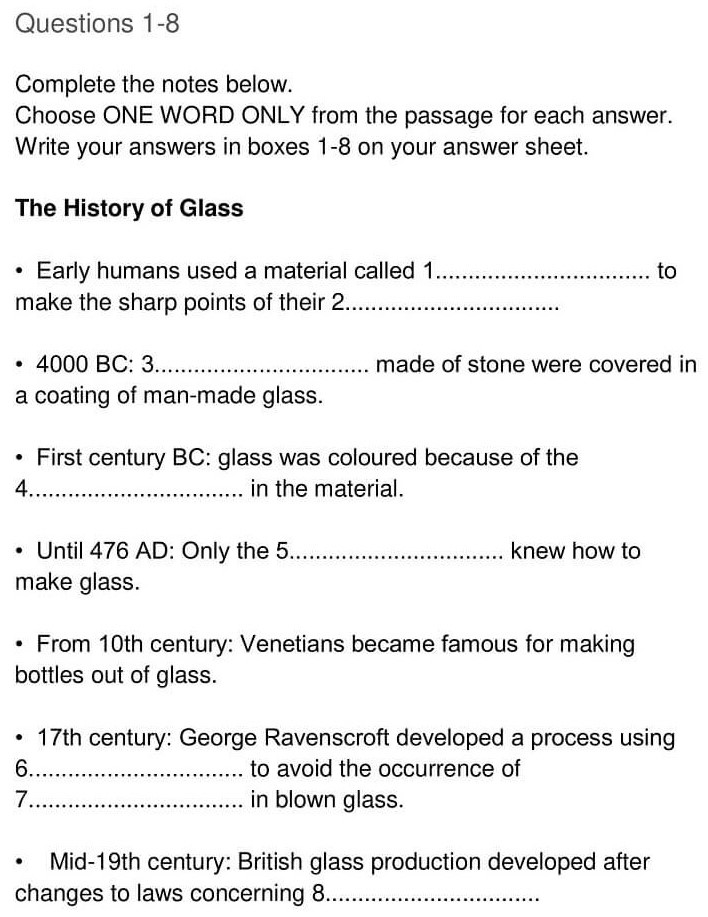
1 |
Obsidian |
The answer for the question is mentioned in the first paragraph that Man has been making glass from the early days. The historians discovered it to be a type of natural glass, Obsidian. So, the answer is Obsidian. |
|
2 |
Spears |
It is mentioned in the first paragraph that a type of natural glass, Obsidian, was discovered and formed in places such as the mouth of a volcano as a result of the intense heat of an eruption melting sand. The Obsidian was first used as a tip for spears. Here, used means to make and sharp points refer to the tips. Thus, the answer is Spears. |
|
3 |
Beads |
In the sixth line of the first paragraph, it is described that in 4000 BC, Archaeologists found evidence of man-made glass, which took the form of glazes used for coating stone beads. So, as per the question, the first thing to be made of stone was beads, covered in a coating of man-made glass. So, the answer is Beads. |
|
4 |
Impurities |
In the third line of the second paragraph, it is mentioned that due to the impurities of the raw material, the glasses made in the first century BC were highly coloured. So, according to the question, the impurities in the raw material led to the colouring of the glasses. Here, highly coloured means colourful. So, the answer is Impurities. |
|
5 |
Romans |
The answer to the question can be located in the second paragraph, where it is mentioned that the secret of glassmaking was taken across Europe by the Romans during this century. However, they guarded the skills and technology required to make glass very closely. It was not until their empire collapsed in 476 AD that glassmaking knowledge became widespread throughout Europe and the Middle East. We understand from the above lines that until the collapse of the Roman Court in 476 AD, only the Romans knew how to make the glasses. So, the answer is Romans. |
|
6 |
Lead |
We can find the reference of the name George Ravenscroft in the third paragraph. So, most probably, the answer can be traced in the 3rd paragraph. It is mentioned that George attempted to counter the effects of clouding that sometimes occurred in blown glass by introducing Lead to the raw materials used in the process. Here, we can understand that George used Lead in the raw material and developed a process. So, the answer is Lead. |
|
7 |
Clouding |
The answer can be located in the second line of the 3rd paragraph that George attempted to counter the effect of clouding that sometimes occurs in blown glass with the introduction of Lead in the raw materials. So, as per the question, to avoid means to counter, we can understand from these lines that George used Lead to develop a process so that clouding can be avoided. Thus, the answer is Clouding. |
|
8 |
Taxes |
In paragraph 4, it is mentioned that in Britain, the modern glass industry only really started to develop after the repeal of the Excise Act in 1845. Before that time, heavy taxes had been placed on the amount of glass melted in a glasshouse and were levied continuously from 1746 to 1845. So, it can be understood from the above lines that in the mid 19th century (1746-1845), glass production in Britain was a problem when heavy taxes were placed on the glass blowing industry. Only after the repeal of The Excise Act in 1845, the industry began to develop. Thus, the answer is Taxes. |
|
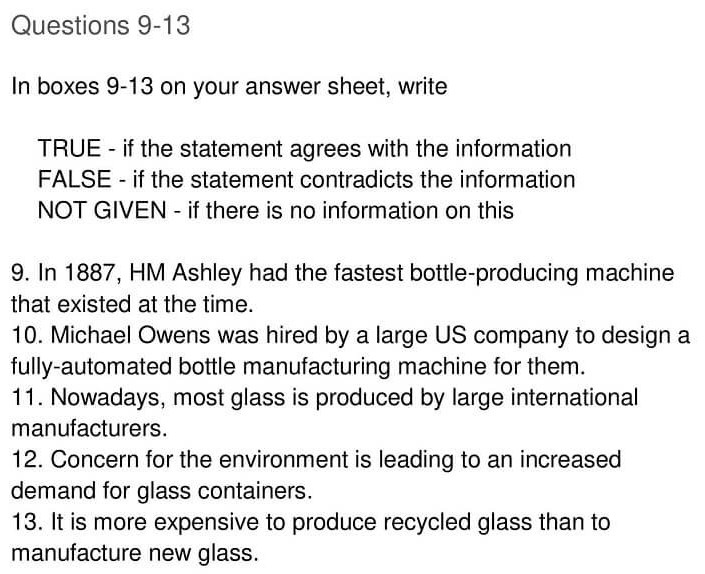
9 |
TRUE |
We can locate the answer in the fifth paragraph, where it is mentioned that HM Ashley introduced a machine capable of producing 200 bottles per hour in Castleford, Yorkshire, and England, three times quicker than any previous production method. Thus, these lines suggest that HM Ashley had the fastest bottle producing machine that existed during that time. So, the answer is True. |
|
10 |
FALSE |
As per the question, the answer can be found in the fifth paragraph, where it is mentioned that in 1907, the first fully automated machine was developed in the USA by Michael Owens, founder of Owens Bottle Machine Company, (later the major manufacturer Owen’s-Illinois) and installed in its factory. These lines clearly suggest that Michael Owens was the founder of a large US company. He was not hired by anyone. Here, founder means owner. So, the answer is False. |
|
11 |
Not Given |
According to the question, we find references to the answer in paragraph 6, where it is narrated that today, glass manufacturing is a big business. However, it is not mentioned anywhere in the passage that whether most glass is produced by large international manufacturers or not. Since enough information is not found the answer is NOT GIVEN. |
|
12 |
TRUE |
The answer can be found in paragraph 7, which states that glass is an ideal material, and with growing consumer concerns for green issues, glass bottles and jars are becoming even more popular. We understand from these lines that the consumers are worried about the environmental issues (green issues), leading to glass production being even more popular. Here, popular refers to increasing demand and green issues means environmental issues. Thus, the statement agrees with the information. As a result, the answer is True. |
|
13 |
FALSE |
In paragraph 7, it is mentioned that as less energy is needed to melt recycled glass than to melt down raw materials, this also saves fuel and production costs. We understand from these lines that recycled glass production saves money and is cost-effective, which means less expensive. So, the answer is False. |
Check More IELTS Reading Answers
| Educating Psyche Answers | Endless Harvest Answers |
| Glass Capturing The Dance Of Light Answers | The Nature Of Genius Answers |
| The Rocket From East To West Answers | Trees In Trouble Answers |
Also check :
Practice IELTS Academic Reading based on question types

Start Preparing for IELTS: Get Your 10-Day Study Plan Today!

Recent Articles

Kasturika Samanta

Nehasri Ravishenbagam

Nehasri Ravishenbagam

Kasturika Samanta


Post your Comments