Eugenics: Word Meaning, Examples, Origin & Usage in IELTS
5 min read
Updated On
-
Copy link
The word ‘eugenics’ means ‘the selection of desired heritable characteristics to improve future generations, typically in humans'. Discover its usage, history & practice using it with the given exercise to expand your lexical resources for a top score.
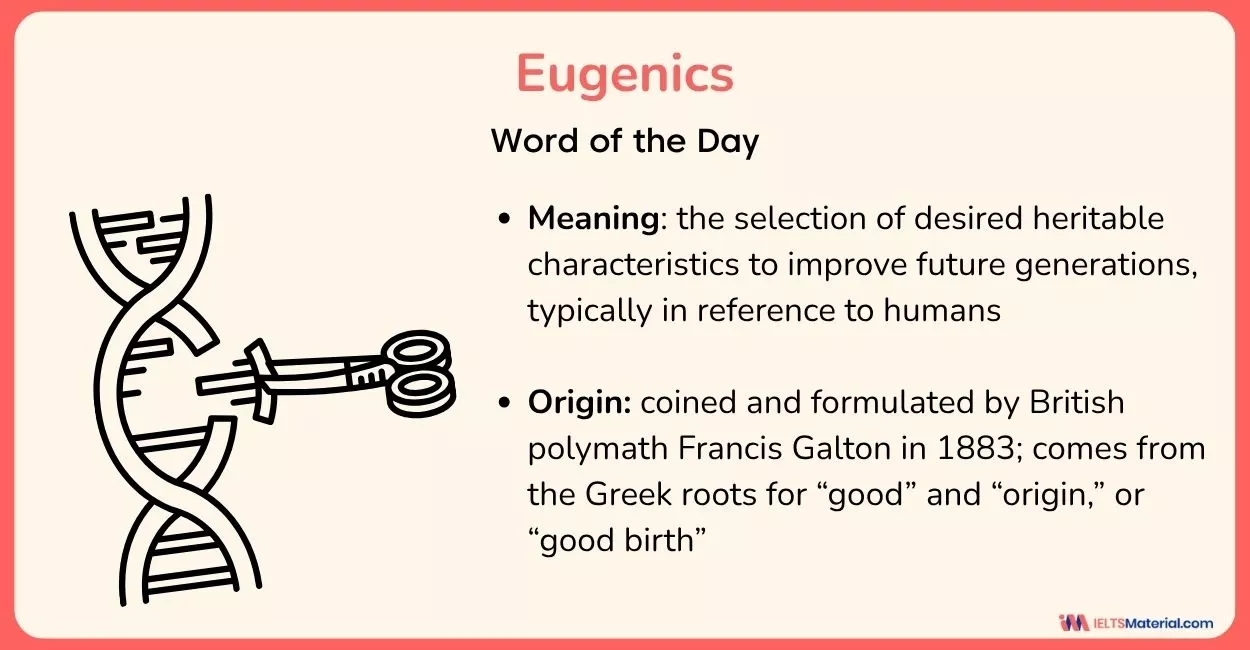
Table of Contents


Limited-Time Offer : Access a FREE 10-Day IELTS Study Plan!
Few words in the English language carry as much historical weight and ethical sensitivity as eugenics. It is not merely a scientific term but one deeply connected to debates about human rights, equality, and morality.
In this blog, we explore the meaning and origins of 'eugenics,' alongside guidelines for its correct use. It contains practical exercises designed to reinforce what you've learned. By adding this word to your IELTS Vocabulary words list for Band 8 or 9, you can improve your chances of achieving your desired score.
Meaning of Eugenics
- Pronunciation: /juːˈdʒenɪks/ (sounds like yoo·jeh·nuhks)
The study of or belief in the possibility of improving the qualities of the human species or a human population, especially by such means as discouraging reproduction by persons having genetic defects or presumed to have inheritable undesirable traits (negative eugenics) or encouraging reproduction by persons presumed to have inheritable desirable traits (positive eugenics).
A person who practices eugenics is called a eugenicist.
History and Origin of ‘Eugenics’
“Eugenics” comes from the Greek roots for “good” and “origin,” or “good birth” and involves applying principles of genetics and heredity for the purpose of improving the human race.
The term eugenics was first coined by Francis Galton in the late 1800’s (Norrgard 2008). This science was popular in America during the early twentieth century, but acquired a dark reputation mainly due to Adolf Hitler’s attempts to create a master race.
Book free IELTS online classes to maximize your vocabulary for the IELTS exam!
Usage & Examples of ‘Eugenics’
Let's examine some example sentences where the word 'eugenics' is used in its noun form.
- Eugenics may seem benevolent and for the good of humanity – it would be great to have no congenital diseases whatsoever. But one must recognise the fact that it can be used for nefarious purposes.
- In the twenty-first century, eugenics has been completely discredited.
- We should move past the negative connotations that eugenics has, and see it as a very powerful tool for transforming humanity, so long as the right people are wielding this power.
- The concept of eugenics has been widely criticised for ethical reasons.
- Governments should avoid policies that resemble eugenics.
- Advances in genetics have revived debates related to eugenics.
- Discussions about eugenics often involve questions of morality and human rights.
IELTS Usage of ‘Eugenics’
It can be an excellent vocabulary for IELTS Writing Task 2 as well as speaking responses. Let us check out some samples to learn how to use this word appropriately during the exam.
IELTS Speaking Part 1
- Question: Should science have limits?
- Sample Answer: “Yes, scientific progress should have ethical limits. For example, ideas related to eugenics show how science can be misused. Without proper regulation, such practices could harm individuals and society.”
IELTS Writing Task 2
- Topic: Some people believe genetic engineering should be used to improve human abilities, while others think it is unethical. Discuss both views and give your opinion.
- Answer Excerpt: Supporters argue that genetic engineering can eliminate diseases and improve the quality of life. However, critics warn that such practices may resemble eugenics, leading to inequality and discrimination. Ethical considerations must therefore guide scientific progress.
Book a FREE demo to talk to our experts and boost your IELTS vocabulary now!
Similar Terms for ‘Eugenics’
While eugenics has no direct synonym due to its specific meaning, some related terms help in paraphrasing and discussion. These words are often used in academic contexts.
The table below provides a list of similar terms related to ‘eugenics’, complete with their meanings and example sentences.
|
Term |
Meaning |
Example Sentence |
|---|---|---|
|
Genetic selection |
choosing genes or traits deliberately |
Advances in science have made genetic selection more precise. |
|
Selective breeding |
breeding plants or animals for particular traits |
Selective breeding is common in agriculture but controversial in humans. |
|
Genetic engineering |
direct manipulation of genes |
Genetic engineering raises both opportunities and ethical concerns. |
Join us in our free webinars to learn tricks to improve IELTS vocabulary! Join Now!
Exercises to Master the Meaning of ‘Eugenics’
Let's complete the exercises given below to help you better understand the term 'eugenics'.
Exercise A: Choose the correct option.
1 Why is eugenics widely considered controversial?
A It promotes biodiversity
B It relies on scientific uncertainty
C It involves morally problematic attempts to control human reproduction
D It focuses only on medical treatment
2 “Several early 20th-century policies were later criticised for being rooted in eugenics.” - What can be inferred?
A The policies were environmentally focused
B The policies aimed at selective population control
C The policies improved equality
D The policies were purely economic
3 Which scenario MOST clearly reflects a eugenics-based approach?
A Restricting reproduction based on perceived genetic traits
B Encouraging education for all citizens
C Providing universal healthcare access
D Promoting cultural diversity
Exercise B: Each sentence below misuses ‘eugenics’. Identify the incorrect usage and rewrite the sentence correctly using the words given below.
|
policies |
gene |
genetics |
DNA |
genealogy |
1 The scientist studied eugenics to understand how plants adapt to climate change.
2 The government introduced eugenics to improve public transportation systems.
3 She used eugenics to describe her interest in family history and genealogy.
Answer Keys
|
Exercise A |
Exercise B |
|---|---|
|
1 C 2 B 3 A |
1 Correct Usage: The scientist studied genetics to understand how plants adapt to climate change. (Eugenics relates specifically to human population control, not general biology.) 2. Correct Usage: The government introduced policies to improve public transportation systems. (Eugenics has no connection to infrastructure or transport.) 3. Correct Usage: She used genealogy to describe her interest in family history. (Eugenics is not about tracing ancestry, but about controlling reproduction.) |
To conclude, IELTS examiners reward candidates who can handle complex and sensitive topics with clarity and balance. Eugenics is a high-level academic term that shows awareness of global issues and ethical debates. So, add it to your advanced vocabulary word list for IELTS and use it accurately to demonstrate strong lexical range and the ability to express complex ideas concisely.
Useful Links:
Explore IELTS Resources

Start Preparing for IELTS: Get Your 10-Day Study Plan Today!

Check out other Word of the Day Articles
Kasturika Samanta
Kasturika Samanta
Haniya Yashfeen

Recent Articles
Kasturika Samanta
Kasturika Samanta
Kasturika Samanta


Post your Comments