A Person Who Can Use or Speak a Second Language - IELTS Speaking Cue Card & Part 3 Questions
Speak fluently for 2 minutes by practising with the IELTS Speaking Cue Card topic, ‘A Person Who Can Use or Speak a Second Language’. Prepare with Part 3 questions to answer analytically by checking out the sample answers and vocabulary words.
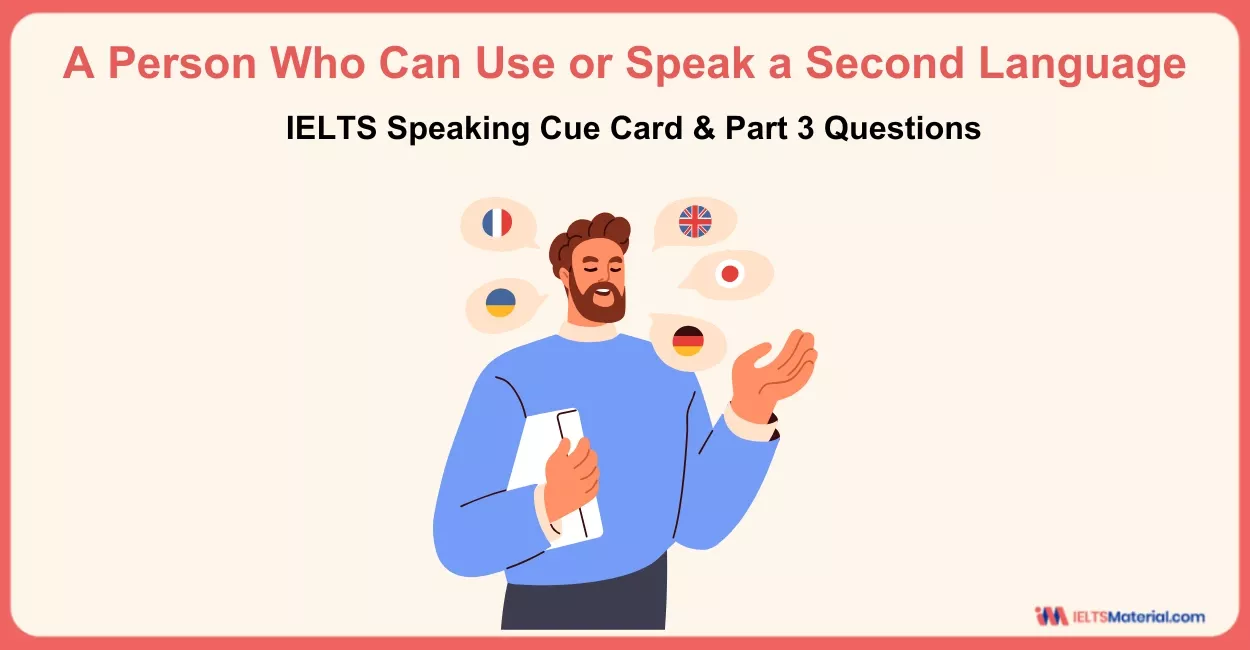
Table of Contents


Limited-Time Offer : Access a FREE 10-Day IELTS Study Plan!
With the cue card topic, ‘A Person Who Can Use or Speak a Second Language’, you would learn strategies to share one of your opinions on a person who can use or speak a second language. Through this topic, you will learn how to structure your cue card answers within one minute of preparation time and speak coherently for two minutes. Practicing with such diverse IELTS Speaking topics, you will learn how to develop your ideas logically in Part 3 and show depth in your answers. This strategy will help you improve your fluency and coherence along with your ability to organise your thoughts quickly.
IELTS Speaking Cue Card on ‘A Person Who Can Use or Speak a Second Language’
Describe a person who can use or speak a second language.
Include:
- Who is this person?
- What language can he/she use?
- How often does he/she use it?
Sample Answer 1 on ‘A Person Who Can Use or Speak a Second Language’
Although many people in my country speak at least two languages, there are a few who can speak or use a foreign language. The curriculum of many schools includes subjects such as French, German and even Sanskrit. However, only a handful of people learn these languages diligently. Even though none of my close friends can use or speak a language other than English and their mother tongue, a college friend of mine is fluent in the French language.
Shyla, who pursued her Bachelor’s degree at the same college as me, was more or less fluent in the French language. She learned this language as part of her high school curriculum. Shyla could speak, read and write in French with remarkable ease. Although she knew other languages like English and Bengali apart from her mother tongue, Hindi, most of our friend circle in college was quite impressed with her French language skills.
Despite the fact that Shyla was quite knowledgeable about the French language, she did not have many opportunities to use her French language skills. One of the reasons for her French skills deteriorating after high school was the lack of practice in the same language. She was also part of our college’s art and culture club, where she used her talents for several events. The knowledge of the French language was also an asset for her when it came to job interviews since employers appreciated different language skills in their candidates, especially for marketing positions. She also used her French language skills when she wrote on her blog, where she sometimes posted French poetry or prose.
Connect with our IELTS Experts to crack your IELTS Speaking and ace the exam with a band 8+! Book a Free Demo.
Sample Answer 2 on ‘A Person Who Can Use or Speak a Second Language’
Initially, I think I can start off by pointing out something about who this person is. Actually, I know quite a lot of people who are bilingual, however I’d like to share about my best friend who is fluent in Japanese. Her name is Nguyen and she is currently working in a Japanese corporation. In fact, she is the one who has inspired me a lot to learn a second language.
The factor that makes her unique to me is the fact that despite acquiring Japanese on her own, she managed to become excellent at it with gorgeous intonation like a native speaker. The chief reason for encouraging her to learn this language is indeed quite simple. When she was in university, she fell in love with a Japanese person and gradually became addicted to this country’s culture and language. Therefore, she exerted herself and put a lot of effort in Japanese with the first target of being able to communicate with her boyfriend in his mother tongue.
Time went by and her passion for this language grew so strong that she committed herself to conquer it, no matter how hard it is when it comes to the matter of self–study. However, at the end of the day, she achieved it with flying colors and lots of opportunities came to her after graduation from university. It is my friend who gives me a precious lesson in life: Do the thing you are truly passionate about and you will rock it.
Join our IELTS webinars to learn master tips to ace your IELTS Writing exam! Click here to explore!
Vocabulary for Cue Card on ‘A Person Who Can Use or Speak a Second Language’
- Bilingual (a): speaking two languages fluently
Eg: Dolly is bilingual in Spanish and French. - Corporate (n): a company or a group
Eg: Mohit moved to Mumbai to work in a corporate office. - Acquire (v): obtain, to get
Eg: She acquired 89.2% in the CAT exam. - Chief (a): most important
Eg: John works as a Chief Executive Officer in the company. - Exert oneself (expression): put oneself to strenuous effort
Eg: If children don’t exert themselves in youth, they will regret it later. - Conquer (v): overcome and take control of something
Eg: Rose conquered the position of HR in the company. - At the end of the day (idiom): finally
Eg: I have to submit my work report at the end of the day. - With flying colors (idiom): successfully.
Eg: Students passed the entrance exam with flying colours.
Explore Person Related Cue Cards for IELTS Speaking to level up your speaking preparation.
IELTS Speaking Part 3 Questions on ‘A Person Who Can Use or Speak a Second Language’
The IELTS Speaking Part 3 questions would help you to analyze information critically without including any personal experiences. Your ability to compare different concepts and analyze how social trends affect bilingualism will be assessed. The sample answers to the following questions on ‘A Person Who Can Use or Speak a Second Language’ will guide you to learn how to create well-developed answers and discuss education systems, globalization, cultural exchange, and career opportunities.
-
Why do you think learning a second language is important nowadays?
The globalized world of today requires people to learn a second language which has become an essential skill. Those who can speak multiple languages build better relationships with others because they can comprehend different cultural backgrounds. Bilingual people demonstrate better cognitive flexibility and problem-solving abilities according to research studies.
-
Do you think children should start learning a foreign language at an early age?
I believe so. Children cultivate on learning languages better because their brains possess greater capacity for language acquisition. The early exposure to language helps children develop proper pronunciation skills while building their self-esteem. Such teaching approach should focus on building student skills through interactive methods but not through testing activities.
-
Do you think technology has made language learning easier?
The answer is yes. Language learning has become more attainable through multiple online applications which allow users to study languages at their own pace. Online platforms let users listen to and speak with native speakers, which helps them develop their listening and speaking abilities. Students need to develop self-control skills which prove crucial for their progress.
-
Why do some people struggle to learn a second language?
People face problems which act as impediments because they lack motivation and have limited exposure to language learning which will make them feel afraid to make mistakes. Some educational systems accentuate grammar rules instead of teaching students how to speak as this will reduce confidence for learners.
-
Is it difficult for adults to learn a second language compared to children?
The difficulty level of adults learning a second language is at a higher level as compared to children. Adults face difficulties with pronunciation and fluency but they possess better discipline. Due to this, they feel zealous to spend more time and learn. Therefore, age factor show less importance than being motivated.
-
Do you think machine translation will replace the need to learn languages?
I don’t believe that machine translation will eliminate the necessity for people to learn foreign languages. The accuracy of a translater keeps improving but they need human communication to operate correctly. This is because machines lack the ability to understand cultural nuances, emotional expressions, and contextual information.
Vocabulary for IELTS Speaking Part 3 on ‘A Person Who Can Use or Speak a Second Language’
- Comprehend: complete understanding of a particular matter
Eg: The students need help to comprehend complex academic texts with proper guidance. - Cultivate: gradual development of a skill or knowledge
Eg: The process of cultivating patience needs to be practiced as it is an essential requirement for learning new languages. - Acquisition: acquiring knowledge about something
Eg: One needs to develop the acquisition of the rules to develop a project efficiently. - Attainable: something can be achieved through dedicated work
Eg: Success in the design industry is attainable with continuous exploration of ideas. - Accentuate: elevate the quality of something to make it noticeable
Eg: While giving a presentation, it is important to accentuate the voice modulation of the speaker - Possess: to have a specific quality
Eg: People who succeed as entrepreneurs need to possess decision-making abilities. - Zealous: someone who shows intense enthusiasm toward an activity
Eg: She practices foreign languages every day as she is zealous about mastering them. - Nuances: variations in meaning
Eg: To communicate effectively, Sara is learning different nuances of the language.
Join our IELTS online classes for expert guidance. Sign up today!
With such diverse topics, you can start learning to organize your ideas and present your viewpoint with clarity. By analyzing the sample answers, you get to learn the correct structure which will help you approach the questions in the IELTS Exam. Such strategic practice sessions will lead to improved results on the exam day.
Explore Other Cue Cards:
Also Check:

Start Preparing for IELTS: Get Your 10-Day Study Plan Today!

Explore other Cue Cards

Kasturika Samanta
Kasturika Samanta
Nehasri Ravishenbagam

Recent Articles
Haniya Yashfeen
Kasturika Samanta
Nehasri Ravishenbagam


Post your Comments