Inscape: Word Meaning, Examples, Origin & Usage in IELTS
The word ‘inscape’ means ‘the unique inner nature of a person or object as shown in a work of art, especially a poem’. Discover its usage, origin, and history, synonyms and antonyms, and enhance your learning by practicing with the provided exercises.
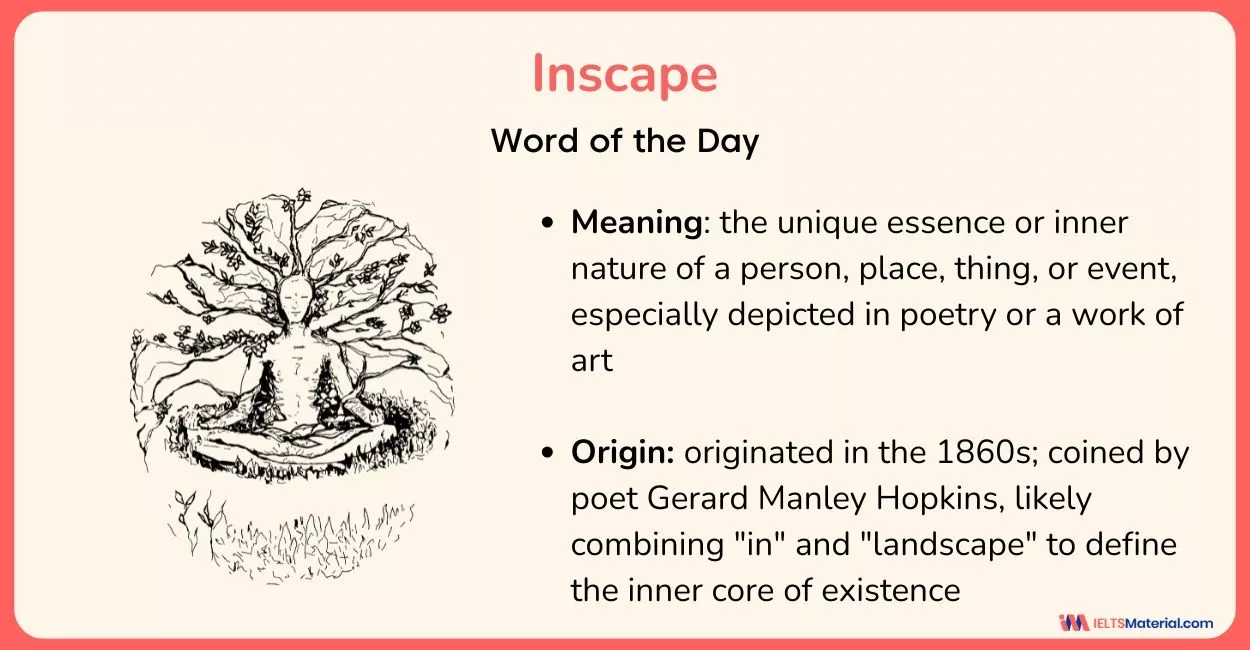
Table of Contents


Limited-Time Offer : Access a FREE 10-Day IELTS Study Plan!
Some words point outward to visible actions, while others quietly turn us inward. The word ‘inscape’ is one such rare and reflective word. It captures the inner essence of things, the unique pattern that exists beneath the surface. In IELTS, where abstract thinking and precise vocabulary matter, it helps candidates express depth, perception, and individuality with sophistication.
So, understand the meaning, history, and proper usage of the term ‘inscape’. Solidify your knowledge through practical exercises and include it in your IELTS Vocabulary words list for Band 8 or 9 to reach your desired score.
Meaning of Inscape
Pronunciation: /ˈɪn.skeɪp/ (sounds like IN-skape)
According to the Oxford Dictionary, the word ‘inscape’ means ‘the unique inner nature or essence of a person or thing’. In other words, it refers to what makes something internally unique, like its character, spirit, or inner design.
It is not a word used for everyday objects or casual talk; instead, it belongs to reflective, literary, and academic contexts. It allows speakers and writers to describe inner qualities rather than outward appearances, making it particularly powerful in higher-band IELTS responses.
History and Origin of Inscape
The word ‘inscape’ was coined in the 19th century by the English poet Gerard Manley Hopkins. He used it to describe the distinctive inner pattern or identity that gives each created thing its individuality.
The word combines “in-” (inner) with “scape” (form or shape), highlighting the idea of an internal landscape.
Join our IELTS online classes and discuss your vocabulary queries with the best experts!
Usage & Examples of Inscape
The sentences below show how ‘inscape’ works naturally in formal and semi-academic English.
- The poet focused on the inscape of ordinary objects to reveal their hidden beauty.
- Cultural experiences shape a person’s inscape over time.
- The film explored the emotional inscape of individuals living in isolation.
- Education should nurture both skills and the learner’s inscape.
- Growing-up is an important inscape of human beings and the rule of nature.
- Here is the inscape, the epiphany, the moment of truth.
IELTS Usage of ‘Inscape’
Advanced vocabulary like ‘inscape’ can significantly raise your lexical resource score when used naturally. Below are IELTS-style questions with model answers.
IELTS Writing Task 2
- Topic: Some people believe education should focus on practical skills, while others think it should develop personal qualities. Discuss both views and give your opinion.
- Answer Excerpt: While practical skills are essential for employment, education should also shape a student’s inscape. Qualities such as empathy, resilience, and ethical awareness influence how skills are used in real life.
IELTS Speaking Part 2
- Cue Card: Describe a piece of art, book, or film that made you think deeply.
- Answer Excerpt: “I would like to describe a novel I read during college that deeply affected me. Rather than focusing on events, it explored the emotional inscape of its main character, showing his fears and moral struggles.”
Synonyms of Inscape
While ‘inscape’ has no perfect substitute, several words convey related ideas. Knowing these helps IELTS candidates paraphrase effectively without losing meaning for IELTS Speaking and Writing, each explained with the word's meaning and a sample sentence.
|
Synonym |
Meaning |
Example Sentence |
|---|---|---|
|
Essence |
the intrinsic nature of something |
The novel captured the essence of rural life without romanticising it. |
|
Inner nature |
a person’s true character |
Her calm speeches reflected her inner nature during the crisis. |
|
Core identity |
central defining qualities |
Education shapes the core identity of young adults. |
|
Inner world |
a person’s thoughts and feelings |
Meditation helped him understand his inner world better. |
Book a FREE demo to talk to our experts and boost your IELTS vocabulary now!
Antonyms of Inscape
Antonyms of ‘inscape’ help clarify meaning by contrast, which is especially useful in IELTS Writing Task 2 discussions.
|
Antonym |
Meaning |
Example Sentence |
|---|---|---|
|
Appearance |
the way someone or something looks |
First impressions based on appearance can be misleading. |
|
Exterior |
the outer surface of something |
The building’s exterior hid its historical importance. |
|
Surface |
the outermost layer |
Social media often shows only the surface of people’s lives. |
Join us in our free webinars to learn tricks to improve IELTS vocabulary! Join Now!
Exercises to Master the Meaning of Inscape
It is now time to complete the following exercises to enhance your understanding of the word 'inscape' and boost your IELTS vocabulary.
Exercise A: Each sentence below attempts to use ‘inscape’, but two contain conceptual errors. Identify the incorrect sentences and rewrite them correctly.
1 The poet’s work focused on the inscape of nature, revealing the inner identity of landscapes.
2 The architect measured the building’s inscape using precise geometric formu
3 Hopkins used inscape to express the unique inner design of living things.
4 The brochure described the hotel’s luxurious inscape, including its spa and rooftop pool.
Exercise B: Identify whether each reflects ‘inscape’ (I) or ‘not inscape’ (N) and give one-line justification.
1 A poet tries to capture the unique inner essence of a dying oak tree rather than its physical appearance.
2 A photographer focuses exclusively on symmetry and lighting in urban architecture.
3 A philosopher describes the unrepeatable identity that makes one human life distinct from another.
4 A travel blogger lists tourist attractions in a city.
5 A novelist explores the silent emotional landscape of a character facing moral collapse.
Answer Key
|
Exercise A |
Exercise B |
|---|---|
|
2 The architect attempted to reflect the inscape of the building through symbolic design rather than measurable geometry. 4 The brochure misused the term, as inscape refers to inner essence, not material amenities. |
1 I – Focuses on the inner, defining essence rather than outward form. 2 N – Concerned with external aesthetics, not intrinsic individuality. 3 I – Emphasises the unique inner identity of a being. 4 N – Informational and external, lacking inner essence. 5 I – Examines internal reality and psychological depth. |
To sum up, high-band IELTS answers reward clarity, precision, and depth of thought. ‘Inscape’ allows candidates to express complex inner ideas without long explanations. When used naturally, it can help push Speaking and Writing responses into the Band 7–9 range, especially in abstract or evaluative topics. So, master using it appropriately by taking up more free IELTS practice tests and improving your vocabulary.
Useful Links:
- Attribute - Word of the Day for IELTS Speaking & Writing
- Qualitative - IELTS Word of the Day for Speaking & Writing
- Feature - Word of the Day for IELTS Speaking & Writing
- Exemplary - Word of the Day for IELTS Speaking & Writing
- Top 11 IELTS Vocabulary Books
- How to Improve Your Vocabulary Score in IELTS Writing and Speaking?
Explore IELTS Resources

Start Preparing for IELTS: Get Your 10-Day Study Plan Today!

Check out other Word of the Day Articles
Kasturika Samanta
Nehasri Ravishenbagam
Kasturika Samanta
Haniya Yashfeen

Recent Articles
Kasturika Samanta
Kasturika Samanta
Kasturika Samanta


Post your Comments